Control Trajectories versus Controller Parameters
Two different control-related decision sets are common:
the time-varying signal or its sampled values; and
parameters in a policy .
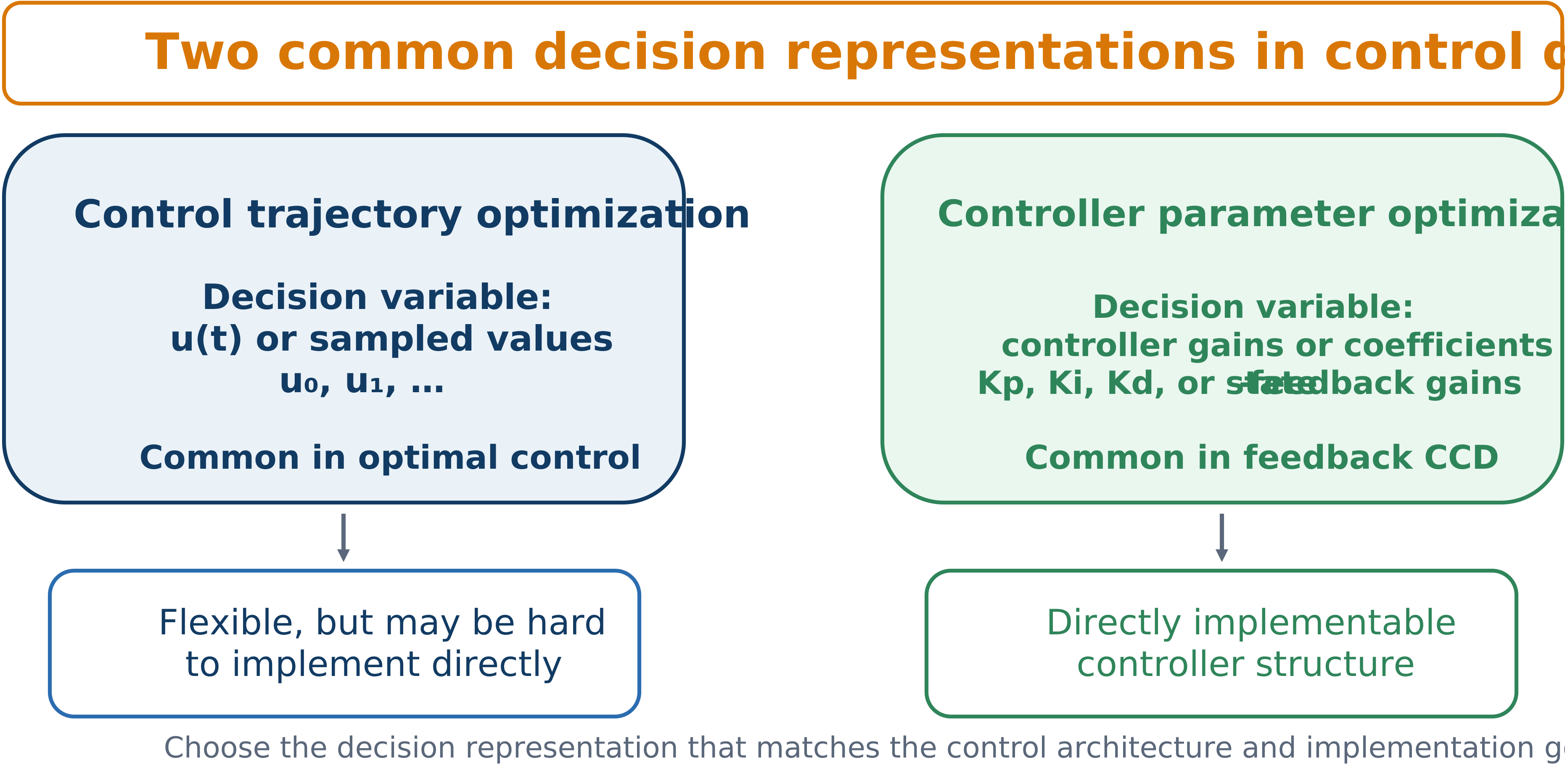
Trajectory optimization chooses a signal; controller-parameter optimization chooses a rule that generates the signal from information.
Optimizing trajectories
A discretized trajectory may use decisions
This offers high flexibility, reveals best-case performance, and matches optimal-control theory. However, the result may be specific to one disturbance realization, difficult to implement directly, and does not itself define feedback.
Optimizing controller parameters
Choose a realizable structure
where contains available measurements. Parameters may be PID gains, state-feedback gains, estimator settings, basis weights, or MPC tuning weights.
This representation is directly implementable, explicitly feedback-based, and often lower dimensional. Its limitation is structural: a restricted controller may sacrifice ideal performance, and selecting the controller architecture is itself a design decision.
Why this matters for plant design
A plant optimized under unrestricted open-loop control may not remain best when paired with a realistic feedback structure. The control representation changes the attainable closed-loop behavior and can therefore change the optimal physical design.
Activity 6.1: Open-Loop versus Feedback Control Co-Design
Activity 6.1: Open-Loop versus Feedback Control Co-Design
Consider the mass-normalized system
The plant variables are
and the actuator-capacity variable is
Use the feedback law
with
Minimize
Use the scenarios
with
Derive the unsaturated closed-loop dynamics.
Derive the conditions on , , , and for asymptotic stability.
Add the passive-safety constraint
Optimize
simultaneously.
For the optimized plant, solve a separate OLOC problem in GPOPS-II or Dymos for each disturbance scenario.
Compute the relative implementation gap
Explain why the plant optimized with unrestricted OLOC may differ from the plant optimized with the parameterized feedback controller.