Open-Loop Optimal Control
A control trajectory is a signal planned over time. A controller is a rule mapping available information to actions during operation. Disturbance, noise, and model uncertainty make exact future behavior unknowable, so most practical systems ultimately require feedback.
Basic formulation
Open-loop optimal control (OLOC) chooses over using a model, initial condition, and assumed future information:
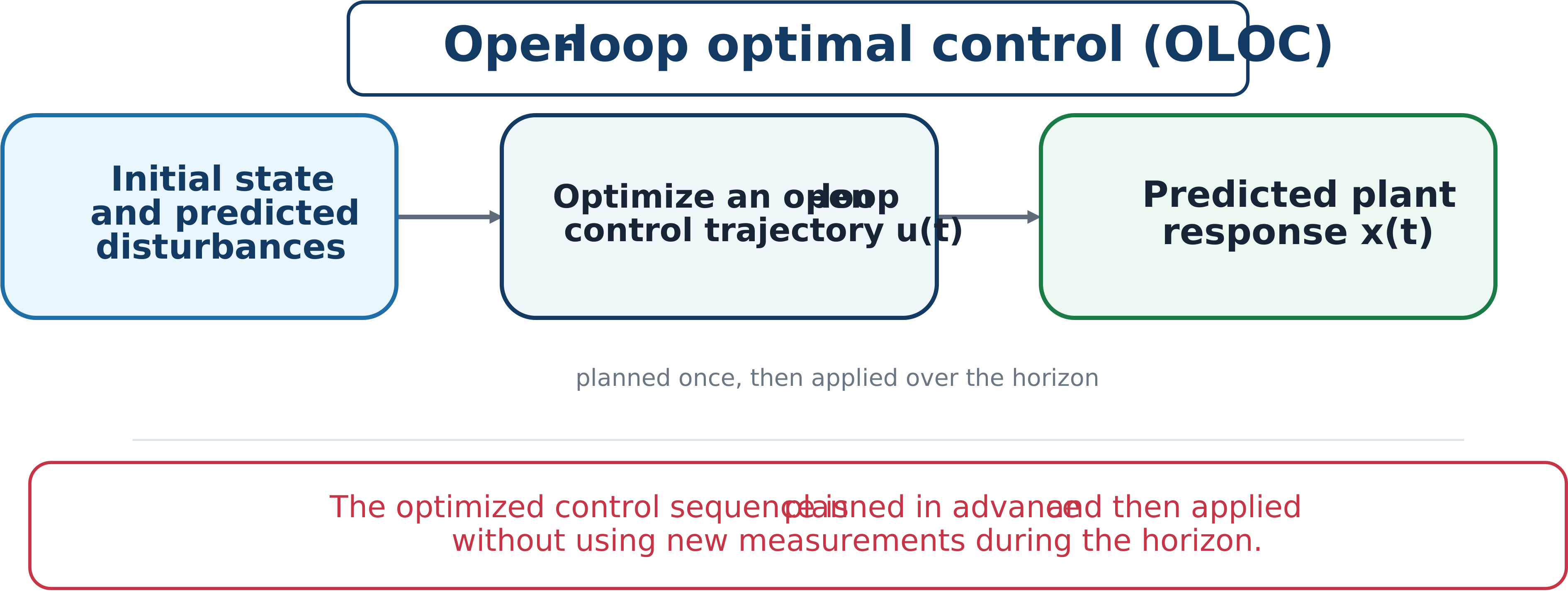
The open-loop trajectory is planned first and then applied as planned.
OLOC can be reasonable when the horizon is short, uncertainty is small, the result is a benchmark, or the trajectory is repeatedly recomputed as in MPC.
Role in CCD
OLOC can answer:
What is the best achievable performance for a candidate plant under an assumed scenario?
How much energy can ideally be extracted or saved?
What qualitative features should control action have?
Which plant properties make the control task easier?
For a wave-energy device, optimizing PTO force against a fixed recorded wave provides an upper-bound energy benchmark. It does not automatically produce a realizable controller, but it exposes valuable plant and control structure.