Feedback-Controller Co-Design
Feedback-controller co-design optimizes physical variables together with parameters of a realizable feedback controller.
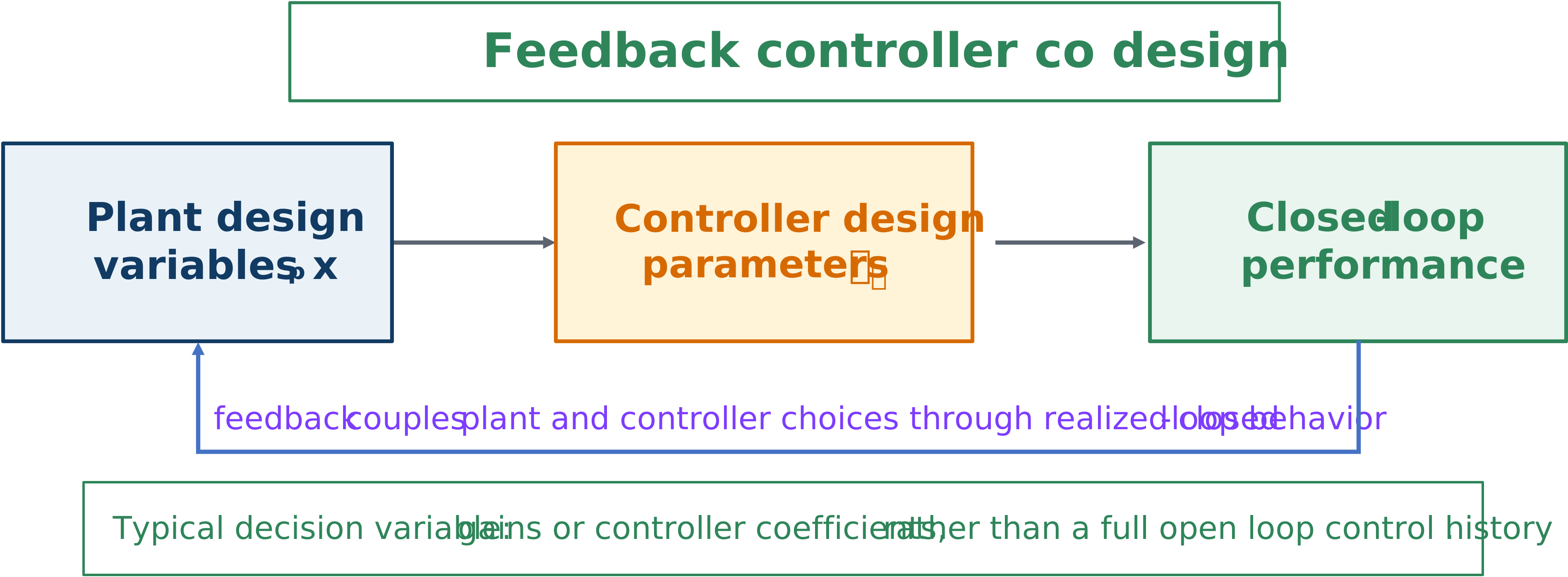
Performance is assessed in closed loop under a parameterized feedback law.
A generic formulation is
The optimizer chooses policy parameters rather than every future control value. The realized response depends on the plant, controller, disturbance, and available measurements.
Why closed-loop co-design is more realistic
Feedback can reject disturbances, reduce sensitivity to model mismatch, and react as state deviations occur. Vehicles, robots, wind turbines, marine devices, and industrial processes therefore operate primarily in closed loop.
For a wind turbine, structural variables and pitch-controller gains can be optimized together. During operation, the controller uses measured rotor speed and other signals to respond to changing wind conditions.
Activity 6.2: Sensor and Output-Feedback Co-Design
Activity 6.2: Sensor and Output-Feedback Co-Design
Consider the stochastic plant
where
and is a plant-design variable.
The process-noise covariance is
Three sensor architectures are available:
and
Use the control-performance weights
Compute the observability matrix for each sensor architecture and determine whether the system is observable for all feasible .
For each value of , solve the LQR algebraic Riccati equation and compute the state-feedback gain .
For each sensor architecture, solve the Kalman-filter Riccati equation
and compute
Construct the LQG controller
For each sensor architecture, optimize using
Estimate the expected cost using at least 200 Monte Carlo noise realizations.
Identify the optimal plant–sensor–controller combination.
Explain why the separation principle does not imply that sensor selection and plant design can be performed independently.