Chapter 6: Optimal Control and Closed-Loop Control Co-Design
From ideal control trajectories to implementable feedback policies
The key distinction is information: an open-loop optimizer assumes a planned future, while a closed-loop controller reacts to measurements as the future unfolds.
Previous chapters formulated CCD problems and compared solution architectures. We now ask: What kind of control object is being optimized?
An optimizer may choose a complete control history over a finite interval, as in optimal control, or choose parameters of a feedback law. The first often gives an ideal performance benchmark; the second usually yields an implementable controller. This chapter connects those viewpoints through feedback-controller co-design, information availability, and model predictive control (MPC).
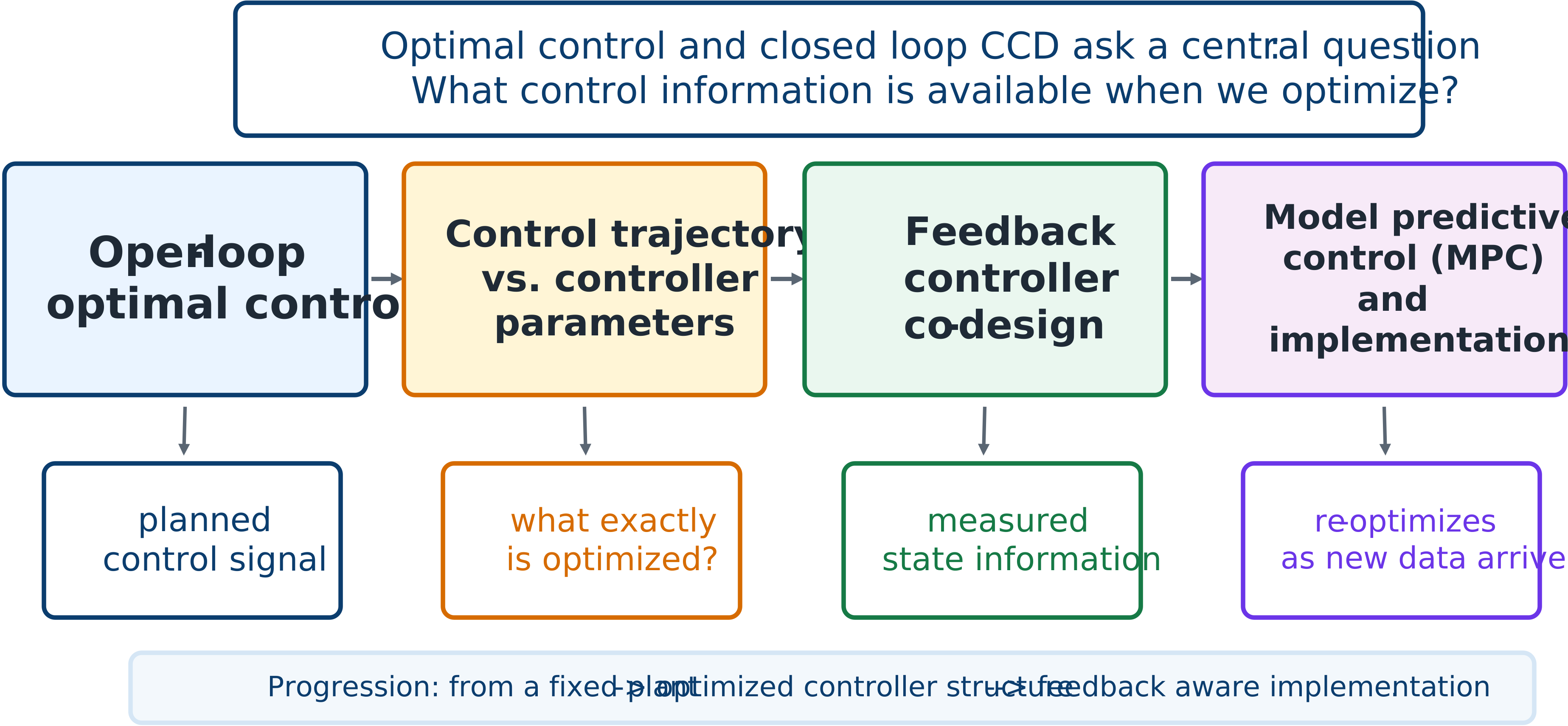
The chapter’s main thread runs from ideal open-loop optimization to implementable closed-loop control.
Learning objectives
After completing this chapter, you should be able to:
explain open-loop optimal control and its role in CCD;
distinguish control-trajectory and controller-parameter optimization;
formulate feedback-controller co-design;
explain the limitations of perfect future information;
classify information available during operation;
explain receding-horizon MPC; and
describe paths from OLOC solutions to implementable feedback controllers.