Chapter 4: A Unified Mathematical Formulation of CCD
One framework for plant, control, state, and architecture decisions
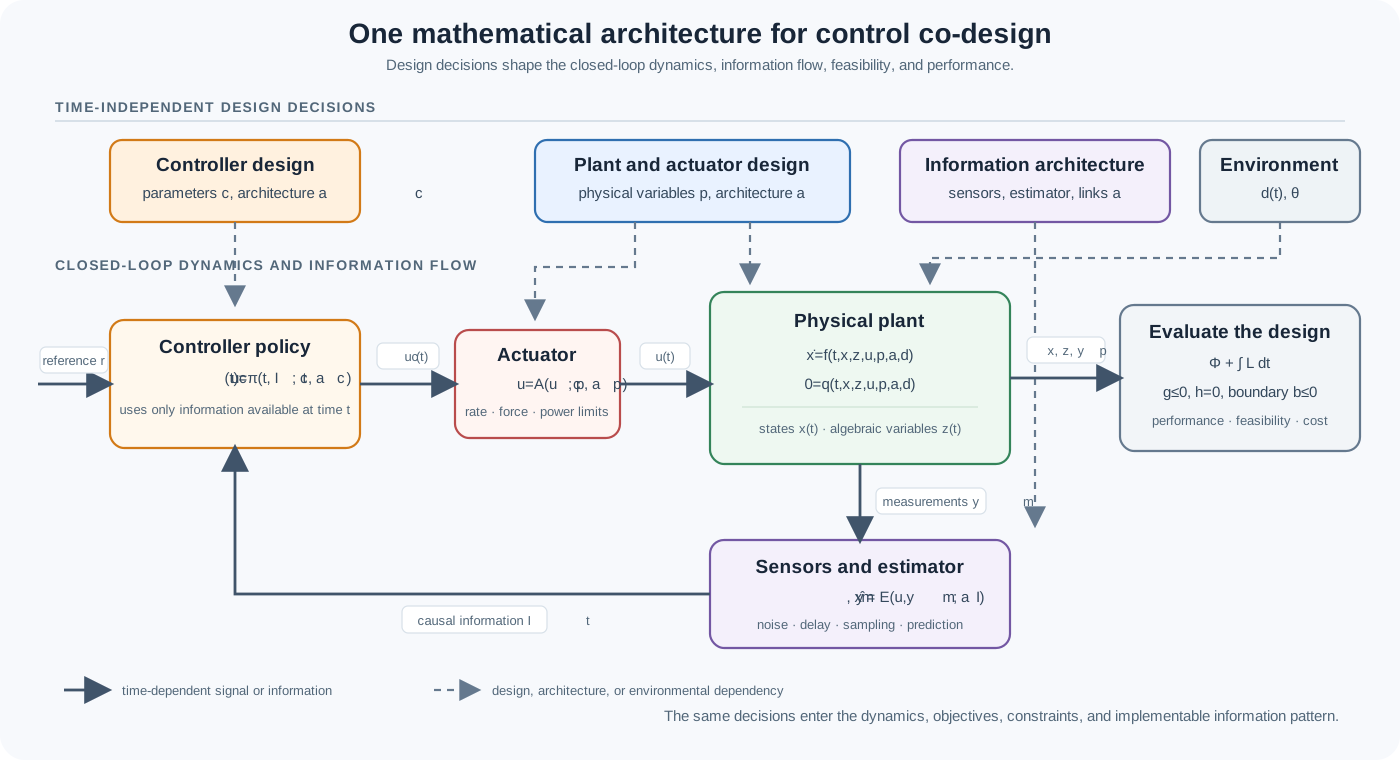
A CCD study becomes reproducible when every decision, model, objective, constraint, information assumption, and source of uncertainty has an explicit mathematical role. This chapter establishes the notation used throughout the course and connects it to physical engineering meaning.
Core formulation
A deterministic finite-horizon CCD problem can be written
Here denotes plant variables, controller parameters, architecture choices, control, differential states, algebraic variables, and prescribed environmental inputs or disturbances. The terminal term and running term define performance. The remaining functions enforce dynamics and admissibility.
Learning objectives
After completing this chapter, you should be able to identify and physically interpret every element of this formulation; distinguish design variables, trajectories, states, algebraic variables, data, and uncertainty; classify objectives and constraints by time dependence; represent continuous and discrete architecture; and place a CCD study within a complete taxonomy.
Running engineering problem
A one-axis electromechanical positioner moves a rigid link. Plant choices include link length and mass, motor rating, and gear ratio. Architecture choices include sensor type and location. Control is represented either by feedback gains or a motor-torque trajectory. Tracking, electrical energy, component mass, and terminal accuracy are optimized subject to dynamics, voltage, current, torque, speed, and geometry limits.