Control Co-Design: Integrated Optimization of Physical and Control Systems
by Saeid Bayat (saeidb@umich.edu; saeidbayat.com)
Overview
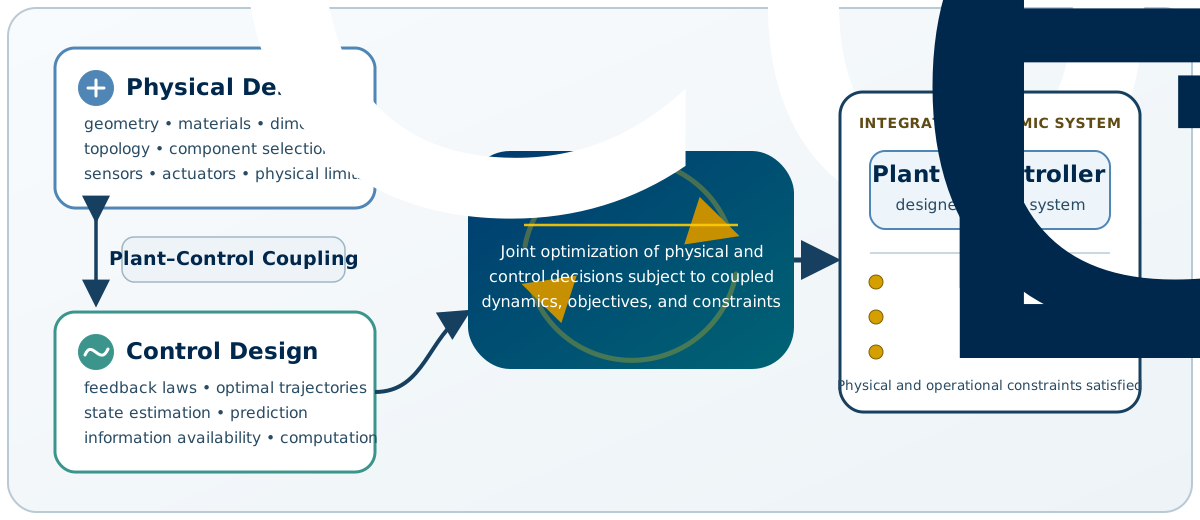
Control co-design integrates physical-system, controller, sensing, actuation, information, and architecture decisions. These notes develop the theory and computational methods needed to design dynamic engineering systems as coordinated wholes rather than as a sequence of disciplinary handoffs. Alongside the mathematical foundations, students encounter practical examples in Python and MATLAB that connect each formulation to engineering interpretation.
A preparatory Chapter 0 reviews mathematical ideas used in dynamic optimization. The remaining twenty chapters are organized into five parts:
Foundations: motivation, feedback, optimization, and a unified CCD formulation.
Formulations and design architectures: sequential baselines, nested and simultaneous CCD, open- and closed-loop formulations, component architecture, and lifecycle objectives.
Computational methods: numerical optimal control, sparse optimization, surrogate modeling, uncertainty, and diagnostics.
Application studies: active suspension, wind energy, marine and hybrid energy, and cross-domain systems.
Deployment and frontiers: controller realization, hardware validation, reproducibility, and future research.
Why Write These Notes?
Control co-design sits at the intersection of dynamics, control, optimization, and physical-system design. Excellent resources exist in each area, but students are often left to assemble the connections for themselves. I wrote these notes to present those connections as one coherent story in which the physical system and its controller are designed as parts of a single engineered system.
My teaching begins with engineering questions rather than isolated techniques. Each chapter develops the mathematics needed to investigate those questions and then returns to examples where students can interpret the results physically. The goal is not merely to find an optimum, but to understand why the design changed, which assumptions produced the improvement, and whether that improvement is credible.
I treat these notes as an evolving teaching laboratory. Reproducible examples make abstract ideas inspectable, visual explanations support different ways of learning, and open questions encourage students to move from applying established methods toward research. My aim is to create a resource that is rigorous, intuitive, and useful when students begin designing real systems.
Acknowledgements and Feedback
I am deeply grateful to my PhD advisor, Prof. James T. Allison, Professor and Jerry S. Dobrovolny Faculty Scholar at the University of Illinois Urbana-Champaign. I learned the foundations of control co-design—and much of how I think about integrated engineering-system design—from him.
I also thank my postdoctoral advisor, Prof. Lei Zuo, Herbert C. Sadler Collegiate Professor of Engineering at the University of Michigan. Through his mentorship, I learned how control co-design can be applied to wave energy converters and other marine-energy systems.
I am grateful to Prof. Daniel R. Herber, Associate Professor of Systems Engineering at Colorado State University. His papers and openly available code have helped me understand and apply many important control co-design concepts.
Finally, I thank Suraj Rampure, teaching faculty in Computer Science and Engineering at the University of Michigan. At the University of Michigan’s Engineering Education Innovation Days workshop, Suraj demonstrated how he uses Jupyter Book to create engaging and accessible course notes. His session inspired me to adopt this approach, and his course template provided a thoughtful starting point for organizing and presenting this book.
AI-assisted tools have been used selectively during drafting and visual development. I review and revise all published material and remain responsible for its accuracy, accessibility, and pedagogical quality.
If you have feedback or suggestions, please contact me at saeidb@umich.edu. I would be glad to hear from students, educators, researchers, and other readers who find these notes useful.
Accessibility
I want all students to be able to engage fully with these notes. The material uses text, equations, diagrams, and computational examples to provide multiple paths to understanding, and I aim to follow WCAG 2.1 AA practices. If you encounter an accessibility barrier, please contact me at saeidb@umich.edu so I can improve the resource.