3.10 Dynamic Systems as Multidisciplinary Design Problems
The transition from static MDO to CCD
Traditional MDO often focuses on coupled static analyses. CCD adds state evolution, control trajectories, feedback information, and time-dependent constraints. This is the central transition developed in the dynamic-MDO perspective of Allison and Herber.
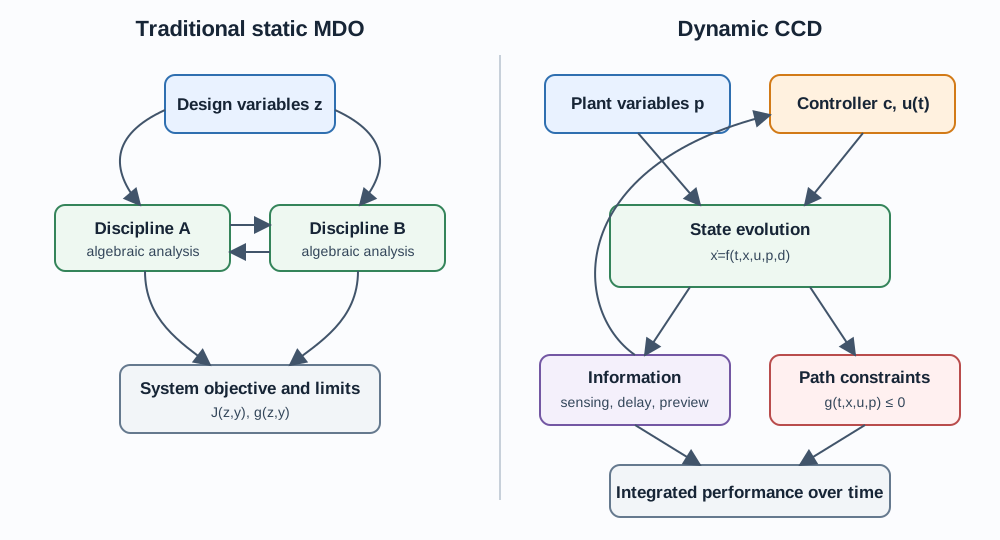
A static multidisciplinary problem may solve algebraic consistency relations
and evaluate and . A dynamic CCD problem additionally enforces
with initial or terminal conditions and limits that must hold along a trajectory. If control is feedback,
where represents the information available at time . Sensor choice, delay, estimation, and prediction horizon can therefore change both achievable control and the preferred plant.
The running suspension as dynamic MDO
The spring and actuator determine mass, passive dynamics, force authority, and cost. The controller determines force demand from measurements or preview. The road excites a trajectory. Ride, energy, displacement, saturation, and stability are evaluated over time. Optimizing only a static spring-deflection relation would omit the coupling that makes this a CCD problem.
A formulation checklist
Before selecting a solution method, identify:
time-independent plant and controller variables;
time-dependent states, controls, disturbances, and outputs;
information available to the controller;
dynamic, algebraic, path, and boundary constraints;
operating conditions and uncertainty descriptions; and
objective terms integrated over time or evaluated at terminal conditions.
Chapter summary
Optimization formalizes preference within a feasible set. Variables may be continuous, discrete, or functional. Active constraints and multipliers explain bottlenecks. Algorithm selection follows smoothness, dimension, derivatives, and discreteness. Pareto analysis exposes tradeoffs. MDO organizes coupled disciplines, while CCD extends that organization to evolving states, control action, information, and time-dependent feasibility.
Common mistakes
treating simulated outputs as independent design variables without consistency equations;
hiding hard requirements inside arbitrary objective weights;
declaring solver convergence to be proof of global optimality;
comparing algorithms with different models, meshes, or tolerances;
ignoring scaling when interpreting multipliers or weights; and
calling a static parameter study CCD when feedback and dynamic feasibility are absent.
Exercises
Formulate the suspension problem using , , and . Include ride and energy objectives plus displacement and saturation constraints.
Replace the continuous actuator rating with three catalog choices. Explain how the variable type and solution strategy change.
Sketch a feasible region in the plane and label boundaries created by travel, authority, packaging, and cost limits.
Construct an -constraint study for ride, energy, and cost. State how each objective will be scaled and validated.
Draw the discipline graph for the dynamic suspension problem, including plant dynamics, control, actuator mass, energy, and cost.
Principal sources
The concise optimization treatment follows Engineering Design Optimization by Allison and Engineering Design Optimization by Martins and Ning. The transition from MDO to time-dependent dynamic-system optimization follows Allison and Herber, “Multidisciplinary Design Optimization of Dynamic Engineering Systems.” Later chapters use the general nested and simultaneous CCD formulations developed by Herber and Allison.
Open research question
Can inexpensive pre-optimization metrics reliably predict when dynamic coupling, feedback information, and active time-dependent constraints will make CCD materially better than a well-coordinated sequential design?