3.5 Equality and Inequality Constraints
Equalities define consistency
An equality constraint usually expresses a law or required consistency: static equilibrium, a geometric relation, an algebraic coupling between disciplines, or a discretized dynamic equation. In CCD, the state equation
is a time-dependent equality constraint. In a simultaneous transcription, its discrete defects appear explicitly in the nonlinear program.
Inequalities define acceptable sides
An inequality defines an allowed side of a boundary. Examples include
Absolute-value constraints are commonly implemented as two smooth inequalities. A constraint is active at a design when and inactive when .
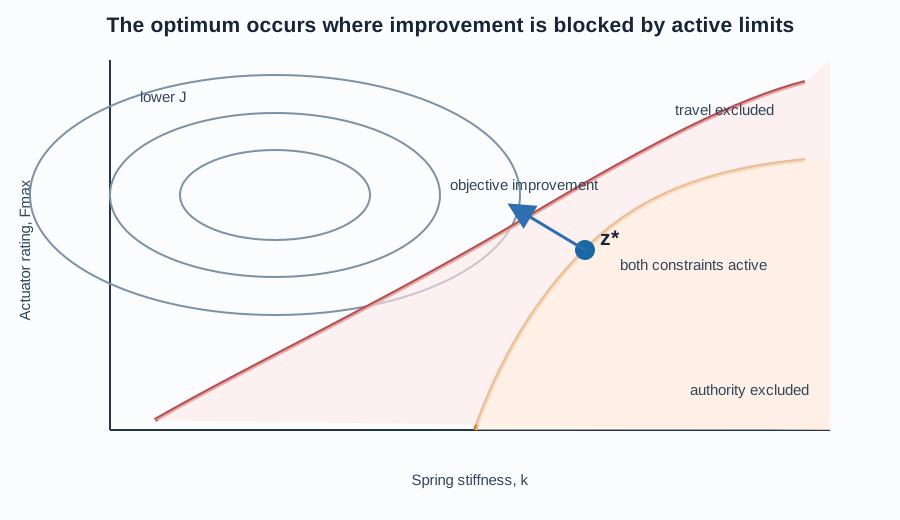
Active constraints explain why an optimum sits where it does. If actuator saturation and suspension travel are both active, more feedback gain cannot improve ride without increasing actuator size or changing the plant. The physical bottleneck is visible in the optimization structure.
Path, boundary, and design constraints
A path constraint must hold throughout time. A boundary constraint applies at the initial or final time. A design constraint depends only on time-independent variables. Checking a path limit only at a few output samples can miss an inter-sample violation.