3.8 Multiobjective Optimization and Pareto Optimality
Tradeoffs should be visible
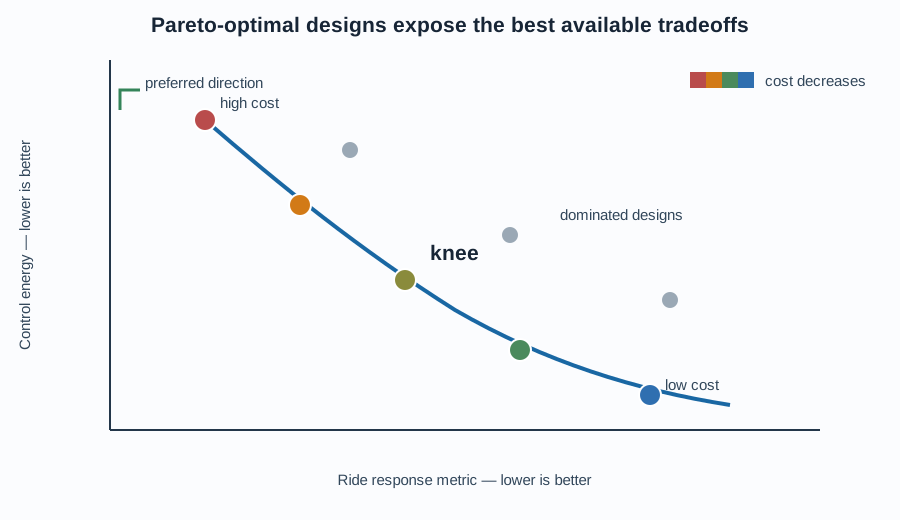
Engineering systems rarely have one natural objective. A suspension may minimize ride response, energy, actuator mass, and cost. A design dominates another if it is no worse in every objective and strictly better in at least one. A design is Pareto optimal when no feasible design dominates it.
The Pareto front exposes the best achievable tradeoffs rather than hiding them inside one arbitrary weight selection.
Scalarization methods
A weighted sum minimizes
where the hats indicate scaled objectives. Scaling is essential: joules, dollars, kilograms, and acceleration cannot be compared through raw numerical magnitude. Weighted sums may miss nonconvex portions of a Pareto front.
The -constraint method minimizes one objective while bounding the others. For example, minimize ride response subject to energy and cost . This form often communicates requirements more clearly.
Selecting a final design
Optimization generates candidates; it does not supply organizational values. A final selection should consider robustness, active constraints, model credibility, manufacturability, controller complexity, and the value of moving along the front. A knee point is attractive when a small further gain in one objective demands a large sacrifice in another.
import numpy as np

# Columns: ride metric, energy metric, normalized lifecycle cost.
candidates = np.array([
    [1.00, 4.8, 1.9], [1.10, 3.8, 1.5], [1.25, 2.9, 1.2],
    [1.45, 2.2, 1.0], [1.30, 3.5, 1.6], [1.70, 2.6, 1.3],
])

def nondominated_mask(values):
    keep = np.ones(len(values), dtype=bool)
    for i, point in enumerate(values):
        dominates_i = np.all(values <= point, axis=1) & np.any(values < point, axis=1)
        keep[i] = not np.any(dominates_i)
    return keep

mask = nondominated_mask(candidates)
print("Pareto candidates:\n", candidates[mask])