Chapter 3: Engineering Optimization and MDO Essentials
The optimization foundation needed for CCD
Control co-design turns an engineering question into a precise search over physical and control decisions. This chapter introduces only the optimization ideas needed for that task: variables, objectives, constraints, feasibility, optimality, algorithm selection, tradeoffs, and multidisciplinary coupling. General optimization theory is intentionally left to the dedicated texts by Allison and by Martins and Ning.
Learning objectives
After completing this chapter, you should be able to:
translate an engineering design statement into variables, objectives, models, and constraints;
distinguish continuous, discrete, and functional decisions;
interpret feasible sets, active constraints, local optima, and global optima;
explain first-order optimality and Lagrange multipliers physically;
select between gradient-based and gradient-free algorithms at a preliminary level;
construct and interpret a Pareto set;
recognize multidisciplinary analysis and optimization structure; and
explain what state evolution, control trajectories, feedback information, and time-dependent constraints add to traditional MDO.
Running engineering problem
A one-degree-of-freedom active suspension is used throughout. Its plant variables are spring stiffness , actuator rating , and—when needed—passive damping . A feedback gain is a control-design variable. Candidate objectives include ride response, control energy, actuator mass, and cost, subject to maximum displacement, actuator saturation, stability, and packaging limits.
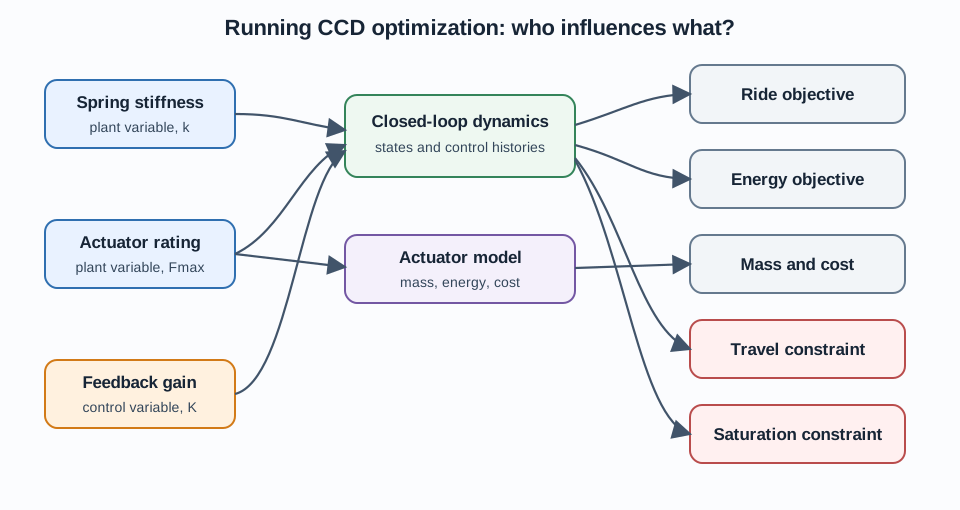
Chapter map
Sections 3.1–3.2 define the decisions and problem elements. Sections 3.3–3.6 develop feasibility and optimality. Sections 3.7–3.8 address algorithm families and multiple objectives. Sections 3.9–3.10 introduce MDO and make the central transition from coupled static analysis to dynamic control co-design.