4.10 A Complete CCD Taxonomy
Describe a CCD study along several independent axes
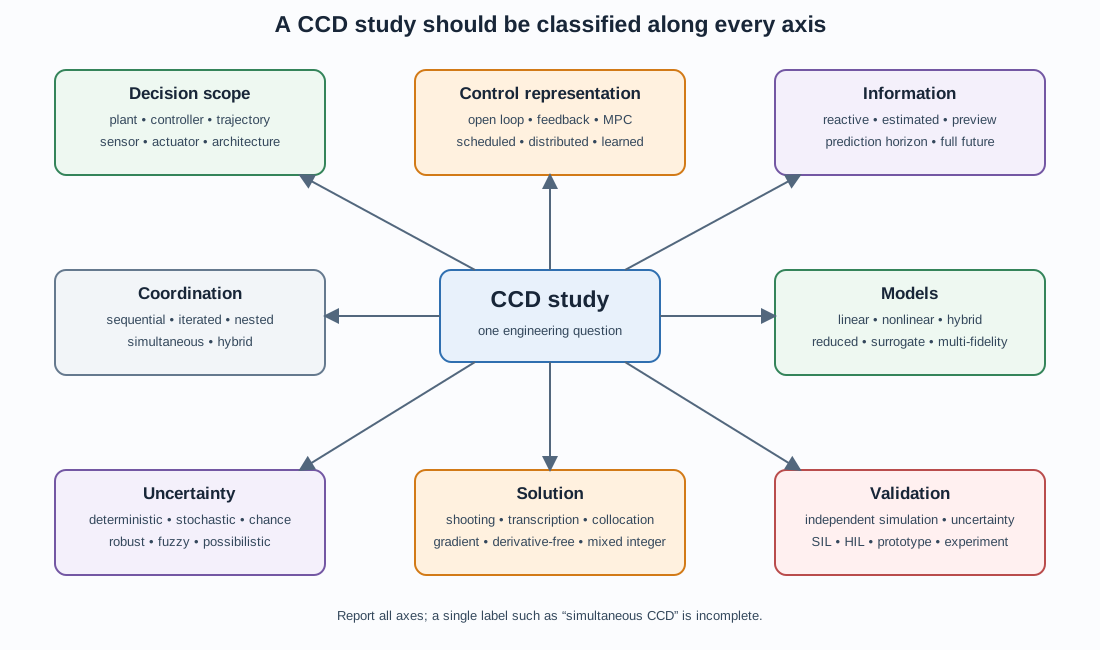
CCD is broader than one optimization architecture. A useful taxonomy identifies what is designed, how control is represented, what information is available, how disciplines are coordinated, what uncertainty is included, and how the problem is solved.
Decision scope
A study may optimize plant parameters, component architecture, sensor and actuator placement, controller parameters, control trajectories, estimation, communication, or several together.
Control representation and information
Control may be open loop, fixed-structure feedback, optimal feedback, MPC, gain scheduled, distributed, or learned. Information ranges from reactive measurements through finite preview to complete future knowledge. These axes must be reported separately: MPC is a controller class, while prediction horizon describes available modeled information.
Coordination
Sequential, iterated sequential, nested, simultaneous, and hybrid strategies organize the coupling differently. Coordination choice does not change the intended engineering problem, although approximations and convergence tolerances can change the solution actually obtained.
Model and uncertainty
Models may be linear or nonlinear, continuous, discrete, hybrid, reduced order, surrogate based, data driven, or multi-fidelity. The study may be deterministic, stochastic, chance constrained, probabilistically robust, worst-case robust, fuzzy, or possibilistic.
Solution and validation
Trajectory optimization may use shooting, transcription, or collocation. The resulting nonlinear or mixed-integer problem may use gradient-based, derivative-free, global, or hybrid methods. Validation may progress from independent simulation through software-, processor-, and hardware-in-the-loop testing to experiments.