Chapter 0: Mathematical Prerequisites
Mathematical and computational foundations for control co-design
Control co-design (CCD) combines plant design and controller design in one integrated problem. Reading, formulating, and solving CCD problems requires a modest but reliable toolkit: mathematical notation, calculus, linear algebra, differential equations, optimization language, time discretization, and basic computational workflows.
This prerequisite chapter does not replace a full course in calculus, linear algebra, dynamics, optimization, or programming. Instead, it provides a focused review of the concepts used throughout the rest of these notes, always from the viewpoint of their later role in CCD.
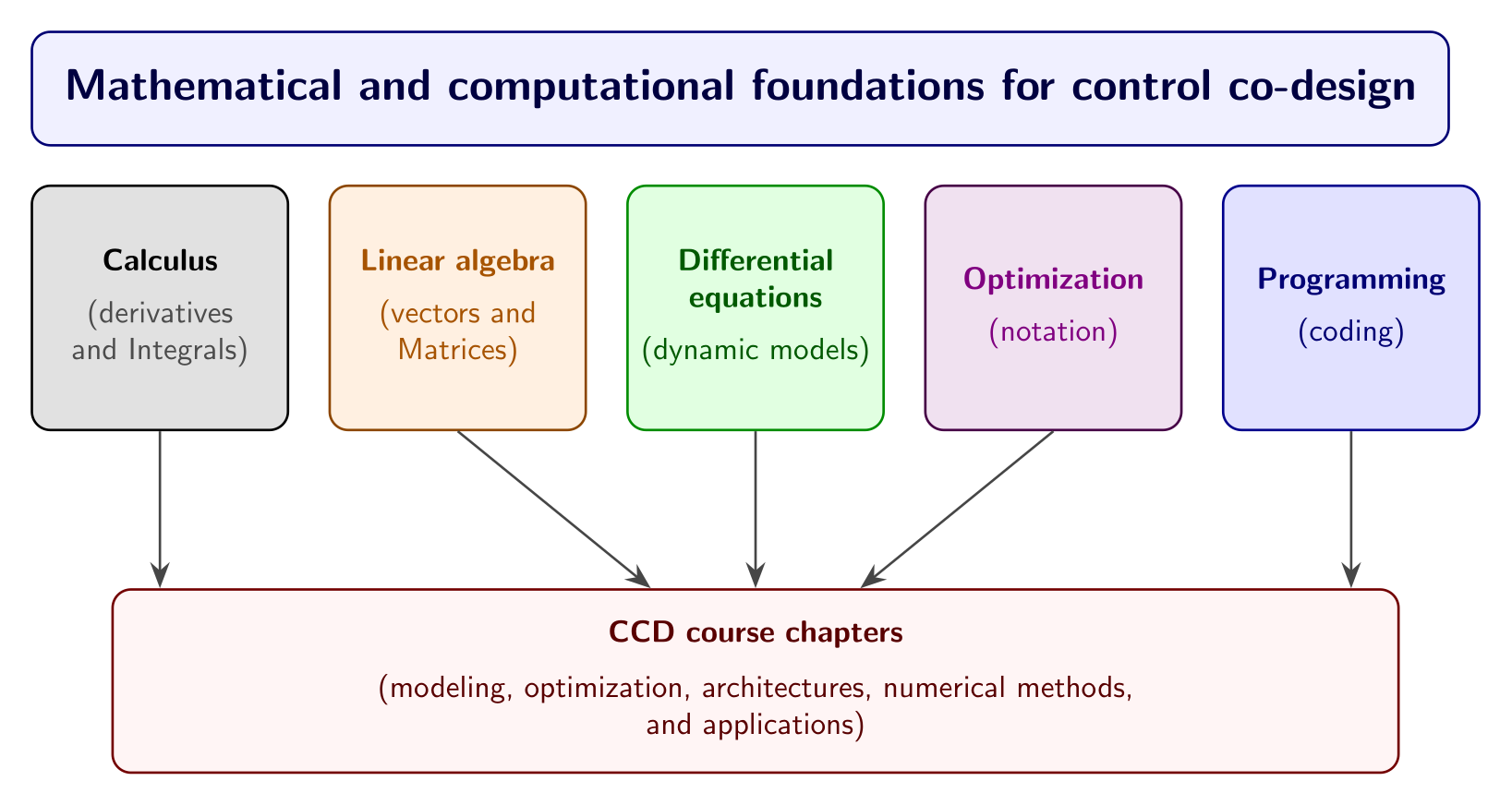
The mathematical and computational foundations that support modeling, optimization, numerical methods, and applications in the remainder of the course.
Learning objectives
After completing this chapter, you should be able to:
read and use the notation that appears throughout the course;
interpret derivatives, partial derivatives, gradients, Jacobians, and Hessians at an introductory level;
interpret definite integrals and basic numerical-integration formulas;
perform basic vector and matrix operations relevant to dynamic-system modeling;
convert a second-order differential equation into first-order state-space form;
read and write a basic optimization problem with variables, objectives, and constraints;
explain how continuous trajectories become finite-dimensional decision vectors; and
understand the minimal programming workflow used in simulation and optimization studies.
Chapter map
The chapter is organized as six focused sections:
Section 0.1 — Mathematical Notation and Engineering Functions: Introduces scalars, vectors, matrices, trajectories, common CCD variables, indexing, summation, bounds, and functional relationships.
Section 0.2 — Calculus and Linear Algebra: Reviews derivatives, gradients, Jacobians, Hessians, integrals, numerical integration, vectors, matrices, norms, eigenvalues, and positive definiteness.
Section 0.3 — Differential Equations and State-Space Models: Converts a mass–spring–damper equation into first-order form and introduces nonlinear and linear state-space notation.
Section 0.4 — Optimization and Discretization: Identifies the parts of an optimization problem and explains how continuous trajectories become finite decision vectors.
Section 0.5 — Computational Preparation and Readiness Project: Presents basic Python and MATLAB simulation workflows and a small preparation exercise.
Section 0.6 — Summary and Problems: Consolidates the chapter vocabulary and provides review problems across all prerequisite topics.