The system is controllable if rank(C)=n. Rank is a yes-or-no structural test. CCD also needs a quantitative question: how much effort is required to move each state or mode?
The finite-horizon controllability Gramian
Wc(T)=∫0TeAtBBTeATtdt
describes reachable directions. Small eigenvalues indicate directions that require large energy. A design can be mathematically controllable but practically uncontrollable because force, stroke, rate, power, or bandwidth is insufficient.
A point actuator couples strongly to modes whose shape is large at the actuator location and weakly to modes near a node. Moving the actuator changes the modal input matrix B(p). Placement should therefore consider the modes that constrain performance, not only geometric convenience.
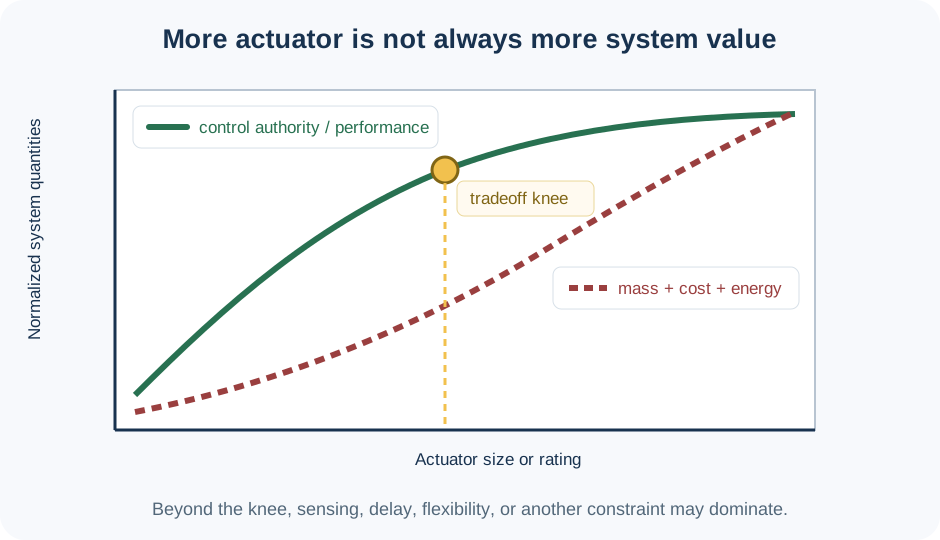
A larger actuator may improve the smallest Gramian eigenvalue and reduce saturation, but it adds mass, volume, heat, cost, and energy demand. Beyond a point, performance becomes limited by sensing, delay, structural flexibility, or another constraint. CCD seeks the knee of this system-level trade, not maximum authority in isolation.