Iterative Sequential Design
Iterative sequential design alternates plant and controller optimization until changes become small.
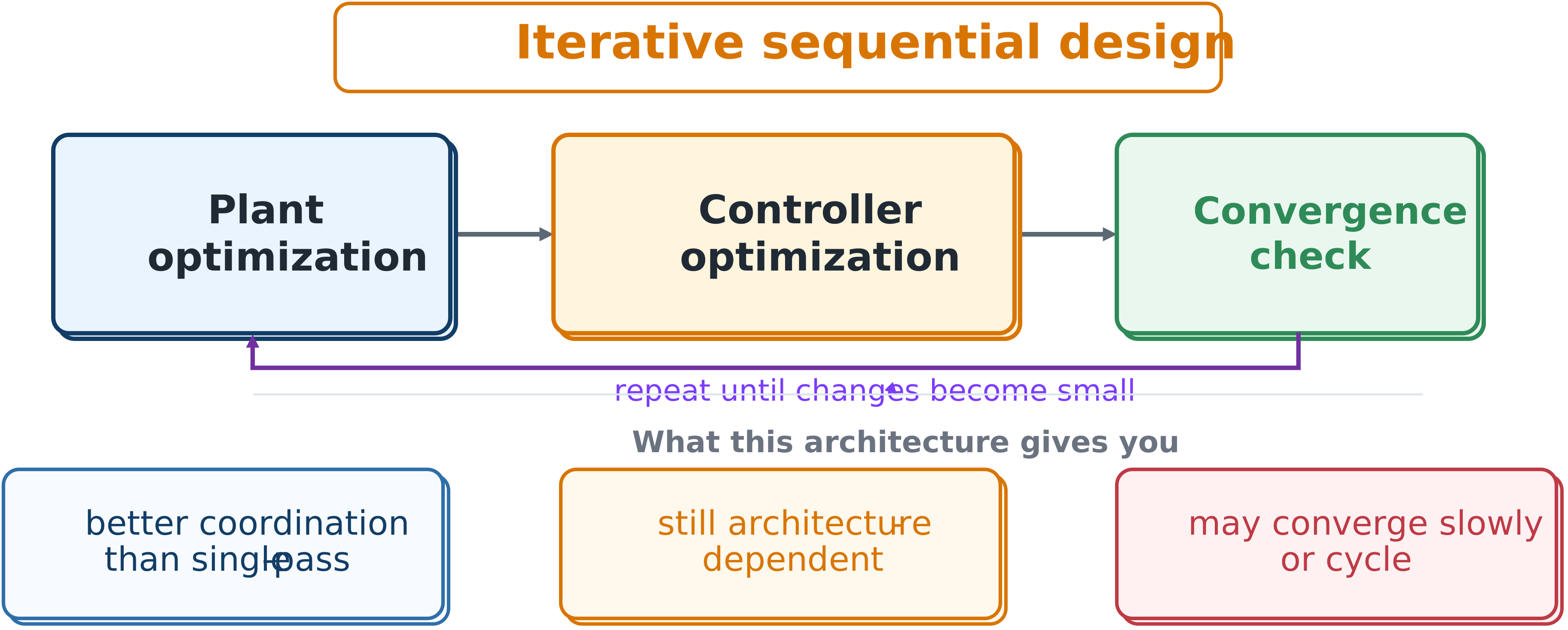
Repeated information exchange provides more coordination than a single pass.
An abstract update is
The plant step uses the current controller, and the controller step uses the updated plant.
Advantages
Can substantially improve on a single-pass design.
Preserves separate plant and controller subproblems.
Reuses legacy models and tools.
Is easier to implement than full simultaneous CCD.
Limitations
Convergence is not guaranteed.
Results can depend on update order.
The process may cycle or converge slowly.
The final point can differ from a fully coordinated optimum.
In strongly coupled problems, each improvement in one discipline changes the best response of the other, making repeated alternation expensive.
Example
A wind-turbine team may alternate structural redesign and pitch-controller retuning. Performance can improve gradually, but many costly simulation-based iterations may be required.
Activity 5.2: Convergence of Iterative Sequential Design
Activity 5.2: Convergence of Iterative Sequential Design
Consider the quadratic CCD problem
where and are symmetric positive-definite matrices. An iterative sequential method performs
Derive the explicit update equations
Let denote the simultaneous optimum. Show that the controller error satisfies
where
Prove that the iterative sequential method converges for every initial controller if
where denotes spectral radius.
Use
and
Compute and determine whether the iterative sequential method converges.
Starting from
perform ten alternating iterations and compare the result with the simultaneous optimum.
Explain how the strength of plant–controller coupling is reflected in .