Equivalence and Computational Tradeoffs
Mathematical equivalence
Nested and simultaneous CCD may target the same underlying problem. If the nested inner controller optimization is solved exactly for every plant and the outer optimization finds the global optimum, it should identify the same pair as a perfect simultaneous method.
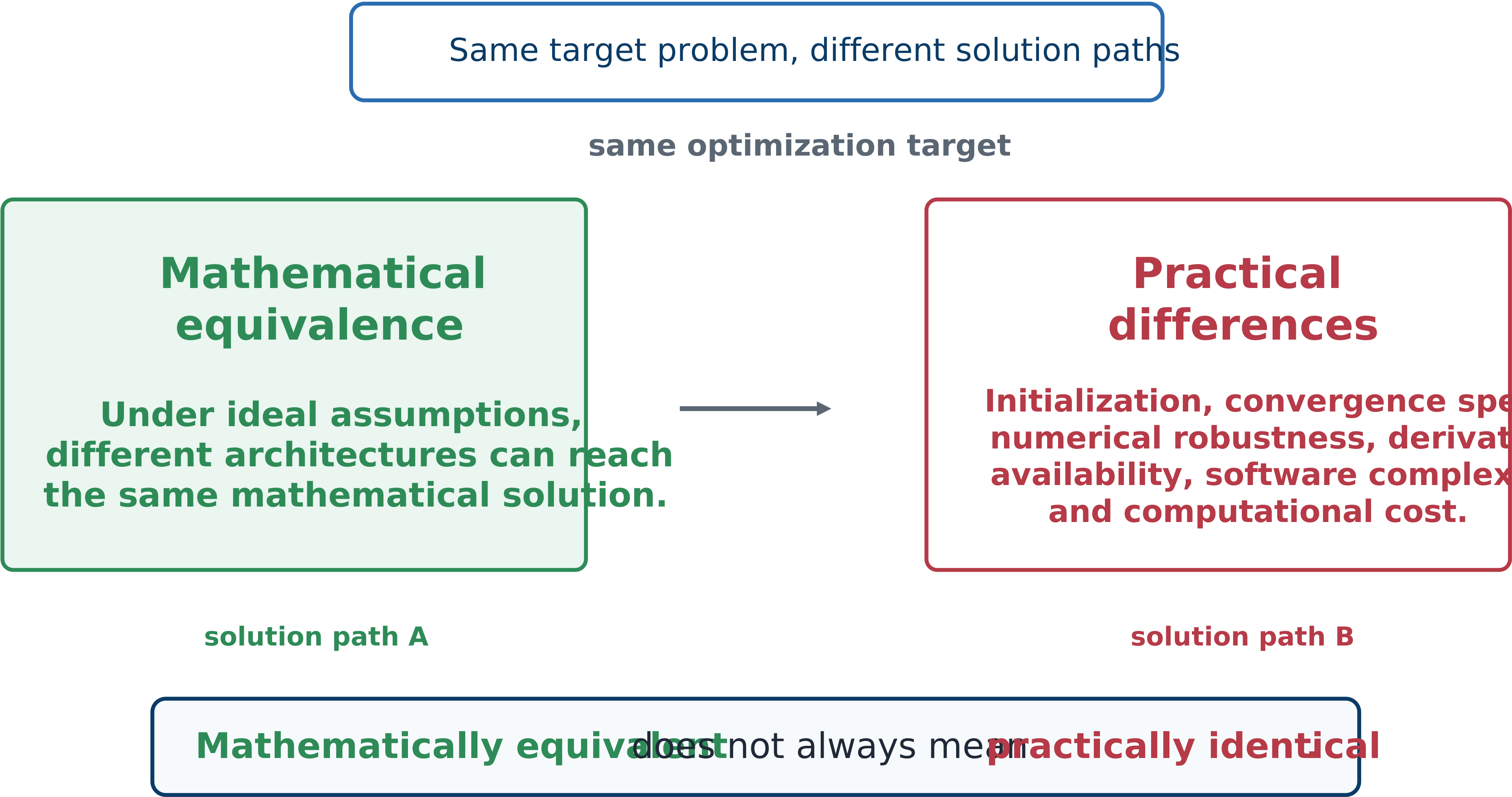
Architectures may be mathematically equivalent under ideal assumptions while behaving differently in actual computation.
Why practical behavior differs
Real optimization is not exact:
Local minima: architectures may converge to different basins.
Initialization: sensitivity differs across formulations.
Approximate inner solves: nested objectives may be evaluated inconsistently.
Derivative quality: simultaneous methods often depend heavily on accurate Jacobians.
Scaling: a large unified nonlinear program can be difficult to balance.
Stopping criteria: different tolerances produce different practical endpoints.
Coordination versus complexity
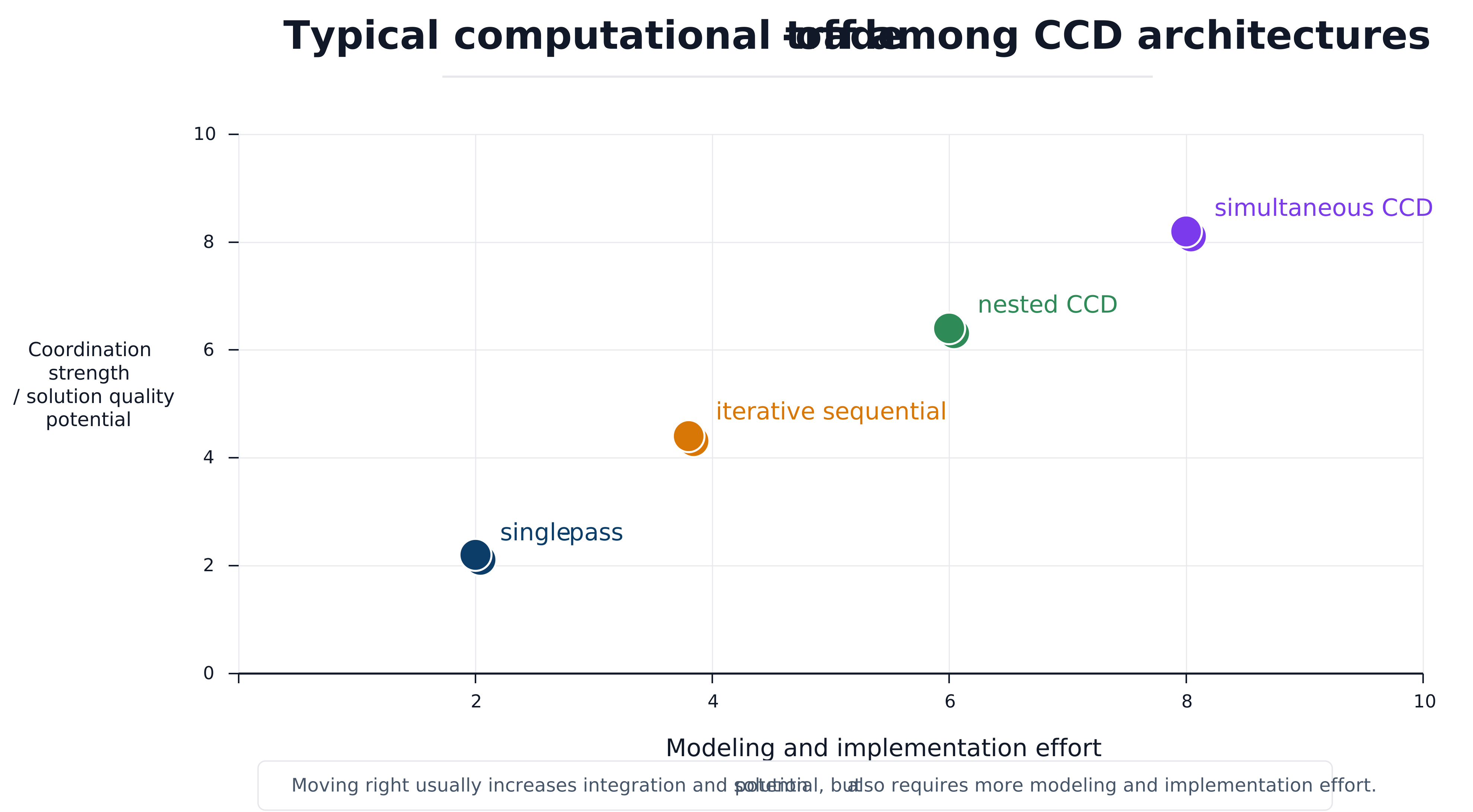
Greater coordination often comes with greater implementation and computational complexity.
The typical pattern is:
Single-pass sequential: lowest setup cost and weakest coordination.
Iterative sequential: moderate effort and coordination.
Nested CCD: strong coordination with potentially expensive repeated solves.
Simultaneous CCD: strongest coordination and often the most demanding integrated formulation.
Simulation cost
Long simulations make repeated nested outer-loop evaluations expensive. A simultaneous solve may avoid repeated full re-optimization but introduces a much larger single problem.
Derivative availability
Reliable gradients can make simultaneous methods highly effective. When derivatives are unavailable, sequential or nested strategies—possibly with derivative-free outer loops—may be easier.
Software and organizational cost
A team with separate plant and controls groups may adopt iterative or nested approaches more readily than a unified simultaneous framework.
Robustness versus optimality
A simpler architecture may be chosen because it is understandable, robust, and compatible with existing tools. Maximum performance may justify the added effort of simultaneous CCD.
Evidence from a controlled comparison
Much of the folklore about which architecture is “faster” compares implementations that were not built with comparable care — a fast simultaneous run with hand-coded analytic derivatives against a nested run with a crude finite-difference outer loop, or the reverse. A more recent controlled study of an active-suspension CCD problem — a quarter-car model with two masses, four states, a controllable force actuator, and physically parameterized spring and damper design variables, solved by direct transcription — deliberately varied only the implementation choices (derivative method, mesh density, and solver tolerances) while holding the problem formulation and solver family fixed, to separate genuine architectural differences from implementation quality.
Two results stand out.
Derivative method dominates the comparison. With enough mesh points () and symbolic derivatives, simultaneous CCD was the fastest and most accurate strategy tested. But symbolic derivatives are a best case that many real dynamic models cannot supply. The complex-step method — nearly as accurate as symbolic differentiation — was on average about slower, and ordinary real-valued (central or forward) finite differences were a further 5– slower than complex-step. Once the comparison is restricted to derivative methods that are actually available for a general nonlinear plant model, the ranking can flip: the nested strategy becomes competitive with, and can be faster than, simultaneous CCD by an order of magnitude or more.
Inner-loop infeasibility is common, not exotic. Uniformly sampling candidate plant designs within their simple box bounds produced an infeasible inner-loop optimal control problem 44% of the time; requiring feasibility with respect to the full constraint set (not just the box bounds) reduced this to about 0.033%, but a naive nested implementation that does not anticipate this can fail outright — in this study, a previously published starting point turned out to be exactly one of the infeasible candidates. A hybrid scheme — one generation of a genetic algorithm to locate a plant design with a feasible inner problem, followed by a gradient-based optimizer — was one practical way to avoid this failure mode.
This connects directly to the outer-loop feasibility constraint introduced for nested CCD: adding such a constraint is exactly the kind of implementation safeguard that keeps the nested strategy from failing on the large fraction of naively sampled plant candidates that would otherwise have no valid inner solution.
Activity 5.6: Computational Benchmark of CCD Architectures
Activity 5.6: Computational Benchmark of CCD Architectures
Consider the controlled oscillator
with feedback
The design bounds are
and
Define
and
For every stable design, let satisfy
Use
and define
Derive the closed-loop stability conditions.
Implement a single-pass sequential architecture:
optimize and with ; and
freeze the plant and optimize and .
Implement iterative sequential design by alternating exact or numerically converged plant and controller subproblems until
Implement nested CCD:
Implement simultaneous CCD:
Use at least ten initial guesses for the nested and simultaneous problems. MATLAB
fmincon, IPOPT, SNOPT, or an equivalent constrained optimizer may be used.Compare
together with function evaluations, derivative evaluations, CPU time, and sensitivity to initialization.
Repeat the nested study with inner optimality tolerances 10-3, 10-6, and 10-9. Quantify the effect of imperfect inner solves on the outer optimum.
Determine whether the best nested and simultaneous solutions agree to within 10-5 in objective value.
Explain any disagreement in terms of local minima, inner-loop accuracy, derivative quality, scaling, or solver termination criteria.