Choosing an Appropriate Architecture
No architecture is always best. Selection depends on coupling strength, simulation cost, derivatives, model structure, available software, and the goal of the study.
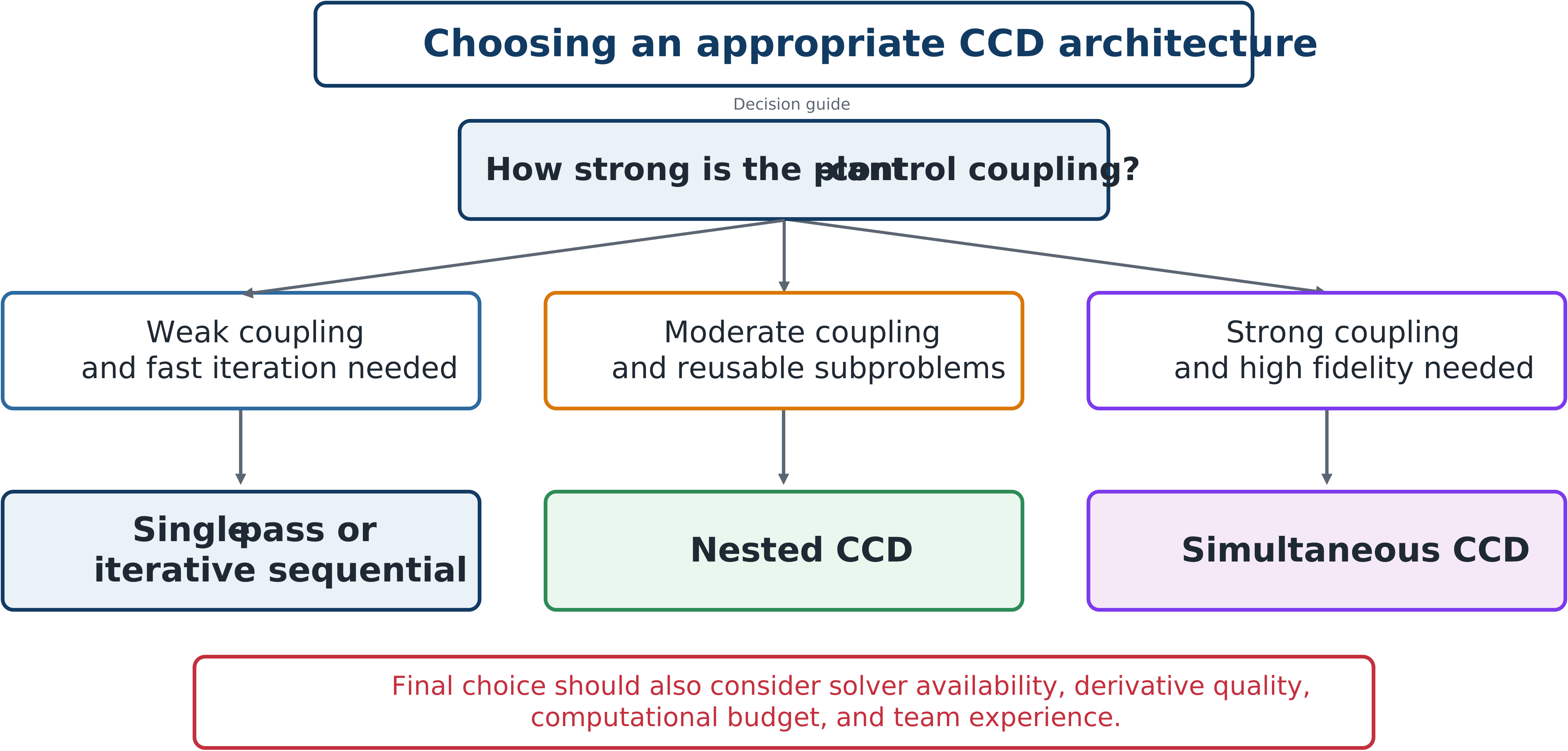
Plant–control coupling is central to architecture choice, but it is not the only consideration.
Favor single-pass sequential design when
coupling is weak;
a quick baseline is needed;
ease of implementation dominates; and
the controller has modest influence on plant tradeoffs.
Favor iterative sequential design when
some coupling exists but full integration is impractical;
separate plant and controller tools must remain;
repeated coordination is affordable; and
moderate improvement over a baseline is desired.
Favor nested CCD when
controller optimization is reliable and well defined;
every plant should be evaluated under best achievable control;
the structure naturally suggests outer plant and inner control loops; and
controller-tool reuse is important.
Favor simultaneous CCD when
plant–control coupling is strong;
maximum coordinated performance is sought;
accurate gradients and modern nonlinear-programming tools are available; and
unified model integration is feasible.
A sharper criterion: what derivatives can you actually get?
A controlled comparison on an active-suspension co-design problem suggests a more specific, checkable version of “favor simultaneous when coupling is strong”: ask first whether the dynamic model can supply symbolic or complex-step derivatives with respect to the plant and control variables. If it can, simultaneous CCD’s coordination advantage tends to show up as a real computational advantage too, especially at fine time discretization. If only real-valued finite differences are available — common with legacy, black-box, or multiphysics simulation codes — nested CCD, using a tailored and reliable inner-loop solver (a closed-form LQR solve, or a quadratic program when the inner problem is linear-quadratic), can be faster by an order of magnitude despite its repeated inner solves. This turns the derivative-availability question already listed below from a soft preference into the single most decisive factor observed in a rigorous, implementation-controlled study.
Questions to ask before choosing
How expensive is each simulation?
Are accurate derivatives available?
How nonlinear and nonconvex is the problem?
How many variables and trajectory points are involved?
Which legacy tools must be preserved?
Is the aim a quick baseline or the best achievable design?