Architecture Landscape and Single-Pass Design
Why architecture matters
A generic CCD problem may be written as
This statement does not say how to organize the optimization. An architecture answers:
Which subproblem is solved first?
Which variables are fixed while others change?
Does plant optimization call controller optimization as an inner loop?
Are all decisions handled at one level or several?
How often is information exchanged?
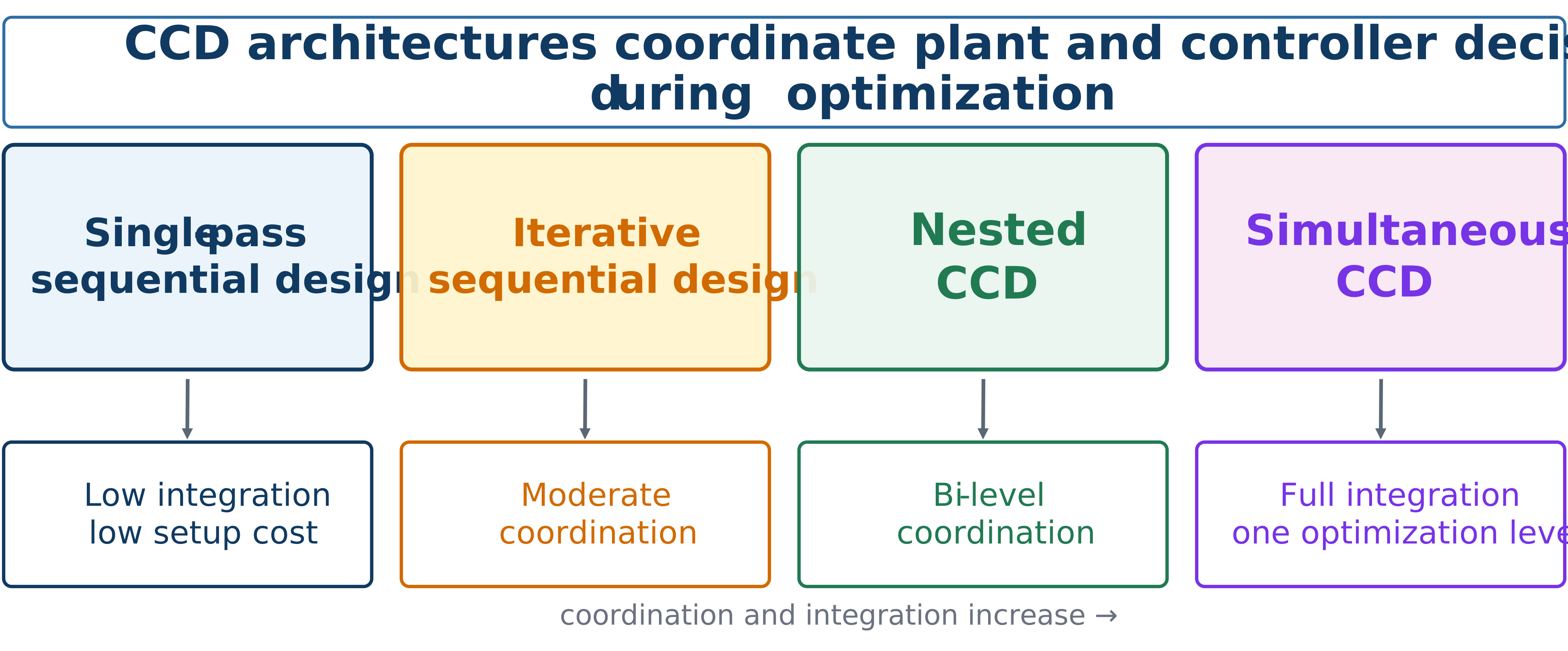
The main CCD architectures differ in coordination strength and implementation cost.
Engineering teams may already have separate plant and controller tools, or may be limited by simulation cost, derivative availability, and software structure. If plant–control coupling is weak, a simple method may be enough. Strong coupling makes weak coordination more likely to miss good designs.
CCD architectures within the broader MDO taxonomy
The four architectures introduced in this chapter are not invented in isolation. Each has a direct analogue in the general multidisciplinary design optimization (MDO) literature, which classifies formulations by how they handle the coupling between disciplinary analyses.
Multidisciplinary feasible (MDF) formulations perform all analysis inside the optimization loop, so every point the optimizer visits is consistent with the system’s governing equations before optimality is reached. Nested CCD is a special case of MDF: the plant design is proposed by the (outer) optimizer, the associated response is obtained for that candidate plant — here, through an inner optimal-control solve rather than a single simulation pass — and the outer optimizer sees only a single reduced objective function value in return.
Individual disciplinary feasible (IDF) formulations instead promote the variables that couple subsystems to the status of independent optimization variables, adding equality constraints that only need to hold at convergence rather than at every iterate. Applied to a dynamic system, this can mean treating a subset of state variables, or entire trajectory segments as in multiple shooting, as optimization variables in their own right. IDF sacrifices guaranteed feasibility during the search in exchange for decoupling the underlying analyses, which is what enables coarse-grained parallel computation across subsystems.
Distributed, multilevel formulations go further and distribute the optimization itself, not merely the analysis, across subproblems. Augmented Lagrangian coordination (ALC) is one such formulation, described in the MDO literature as a nonhierarchical generalization of analytical target cascading (ATC), an earlier multilevel coordination strategy. In ALC, each subsystem — for example, each time segment of a discretized trajectory — solves its own local optimization problem using a local copy of the shared coupling variables, and a coordination algorithm drives the local copies toward agreement through an augmented Lagrangian penalty rather than a hard equality constraint.
Single-pass sequential design
The plant is designed first using a nominal controller or simplified control assumption. The chosen plant is then fixed while the controller is optimized.
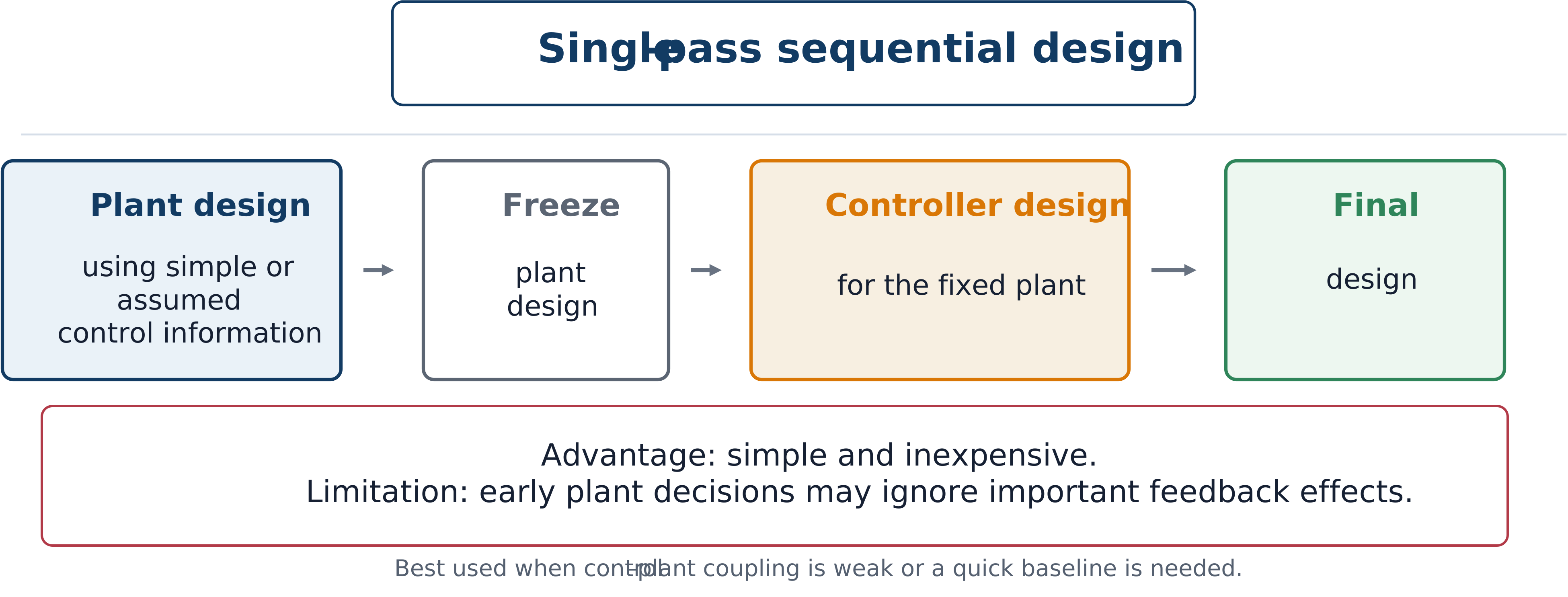
Single-pass sequential design makes one pass through the two stages.
A simple mathematical representation is
where is an assumed controller.
Advantages
Easy to explain and implement.
Reuses existing disciplinary workflows.
Requires little optimization infrastructure.
Can work when plant–control coupling is weak.
Limitations
Early physical decisions ignore how an improved controller might alter plant tradeoffs. A passive structure may be oversized because feedback load reduction was not considered. The method is simple, but coordination is weak.
Example
If suspension stiffness and damping are selected using passive metrics and an active controller is added afterward, the process may miss a softer plant that delivers better comfort under feedback while still meeting handling constraints.
Activity 5.1: Exact Comparison of Four CCD Architectures
Activity 5.1: Exact Comparison of Four CCD Architectures
Consider the unconstrained control co-design problem
where is a plant-design variable and is a controller-design variable.
Verify that is strictly convex.
In a single-pass sequential design, first optimize using the nominal controller , and then optimize for the fixed value of . Compute
Formulate the nested problem
Derive and the reduced objective .
Solve the nested problem analytically.
Solve the simultaneous problem by imposing
Show that the nested and simultaneous solutions are identical.
Compute the relative performance loss of the single-pass sequential design:
Explain why strict convexity is important for the equivalence observed in this problem.