Sharing Our Hybrid Wind–Wave Energy Research Through The Science Matters
Published:
One of the reasons I enjoy doing research is that every project starts with a simple question. For this project, the question was:
Why should an offshore platform harvest only the wind when the waves beneath it contain so much energy as well?
That question stayed with me for a long time. Offshore wind turbines have become one of the fastest-growing renewable energy technologies, yet they operate in an environment where another abundant energy source is continuously available. It seemed natural to ask whether a single platform could efficiently harvest both resources instead of just one.
This curiosity eventually led to one of my favorite research projects. Together with my collaborators at the University of Michigan, we developed a hybrid floating platform that combines a large offshore wind turbine with three flap-type wave energy converters integrated directly into the floating structure. Rather than treating the wave devices as separate add-ons, we designed them to become part of the platform itself, allowing them to both generate electricity and contribute to the stability of the floating system.
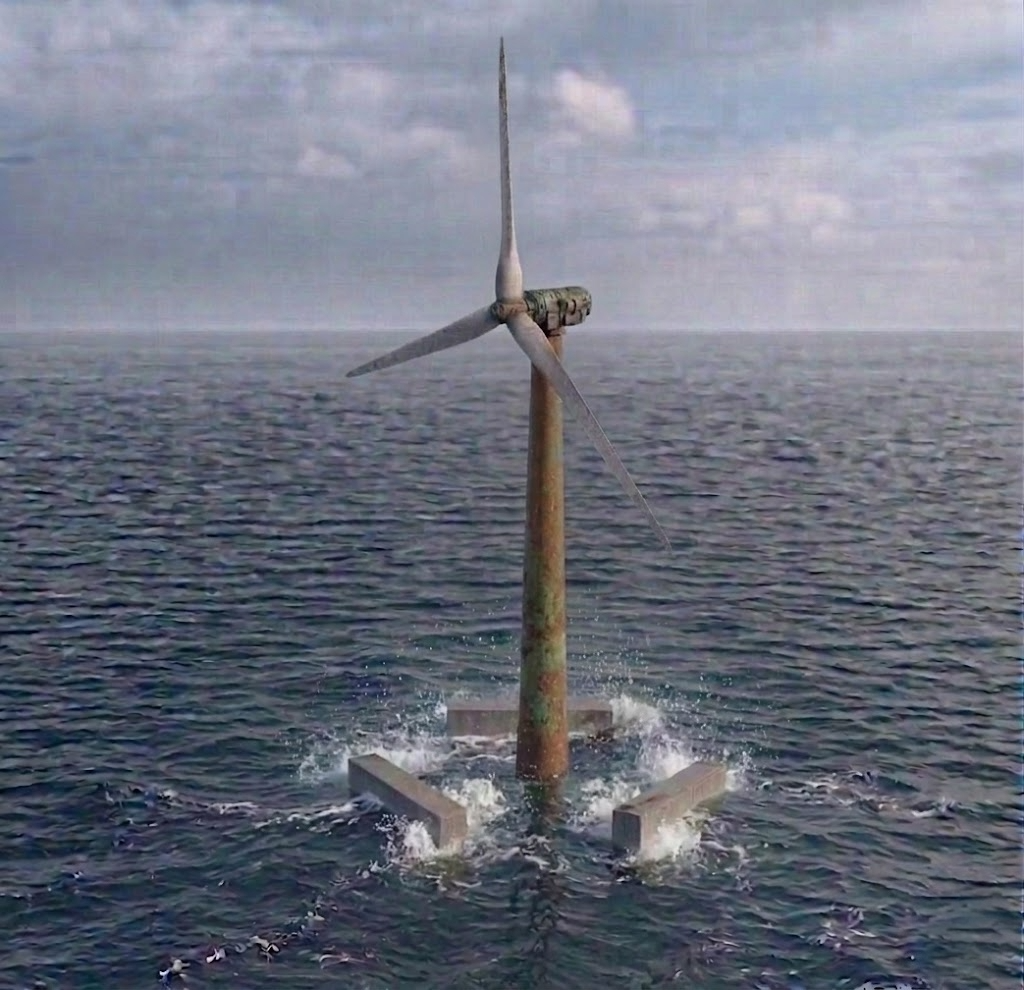
A hybrid floating wind–wave platform integrating an offshore wind turbine with three flap-type wave energy converters.
What made this project especially enjoyable was that it brought together many of the topics I enjoy most: dynamics, control, renewable energy, numerical modeling, and multidisciplinary engineering. Understanding how all of these subsystems interact required looking at the platform as one integrated system rather than a collection of independent components. That way of thinking is also at the heart of my research on control co-design.
I was particularly excited when our simulations showed that the wave energy converters could contribute nearly 18% additional annual energy production while simultaneously influencing the platform's hydrostatic stability. Seeing one design feature improve multiple aspects of system performance is always satisfying as an engineer because it demonstrates the value of considering interactions between disciplines instead of optimizing each subsystem independently.
Recently, I had the opportunity to share this work with a broader audience through The Science Matters. As researchers, we often communicate primarily through journal articles written for specialists. While those publications are essential, I also believe it is important to explain our work in language that students, engineers from other fields, and anyone interested in renewable energy can appreciate.
Looking ahead, I believe hybrid offshore renewable energy systems will become an increasingly important research area. As offshore wind farms continue to expand around the world, integrating complementary technologies such as wave energy could improve energy production, reduce infrastructure costs, and make better use of our oceans. I am excited to continue exploring these ideas and hope they will contribute, even in a small way, to a more sustainable energy future.
If you are interested in learning more about the project, you can read the full article published by The Science Matters here:
https://thesciencematters.org/a-floating-platform-that-captures-both-wind-and-wave-energy/