
Courses
- Control Co-Design — integrated physical-system and controller design
- Optimal Control — theory, numerical methods, and engineering applications
1. Control Co-Design Explore the course notes
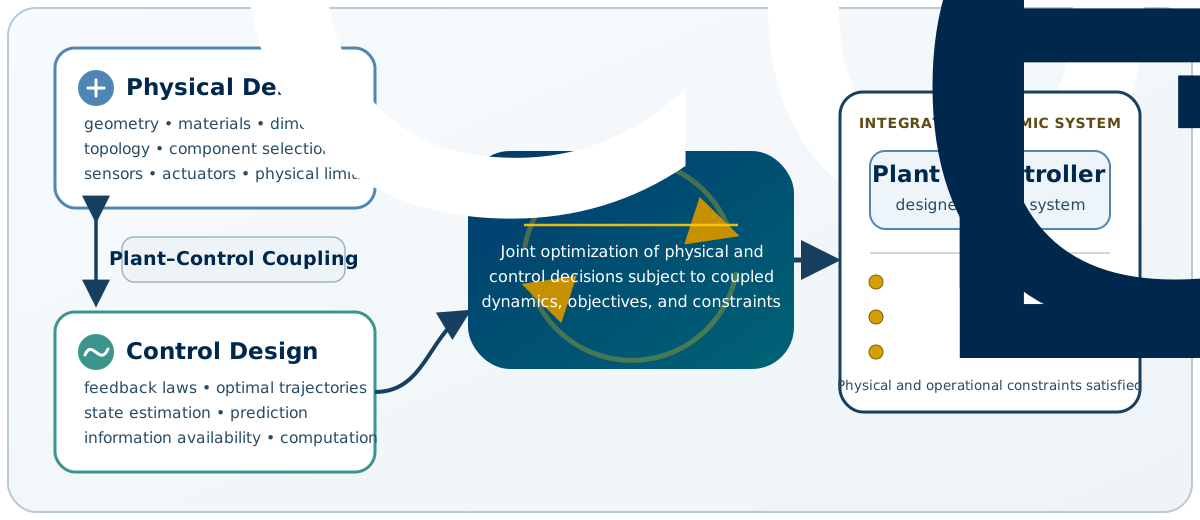
I developed this elective course for senior undergraduate and graduate engineering students. It is intended for students who have studied dynamics, control, or optimization separately and are ready to examine how decisions about a physical system change what its controller can achieve—and how control requirements can reshape the physical design.
The course progresses from mathematical foundations through dynamic-system modeling, feedback control, and engineering optimization to unified control co-design formulations. Through worked examples, computational notebooks, and multidisciplinary applications, students analyze plant–controller tradeoffs, compare design architectures, and test how modeling assumptions influence an optimized system.
2. Optimal Control Explore the course notes
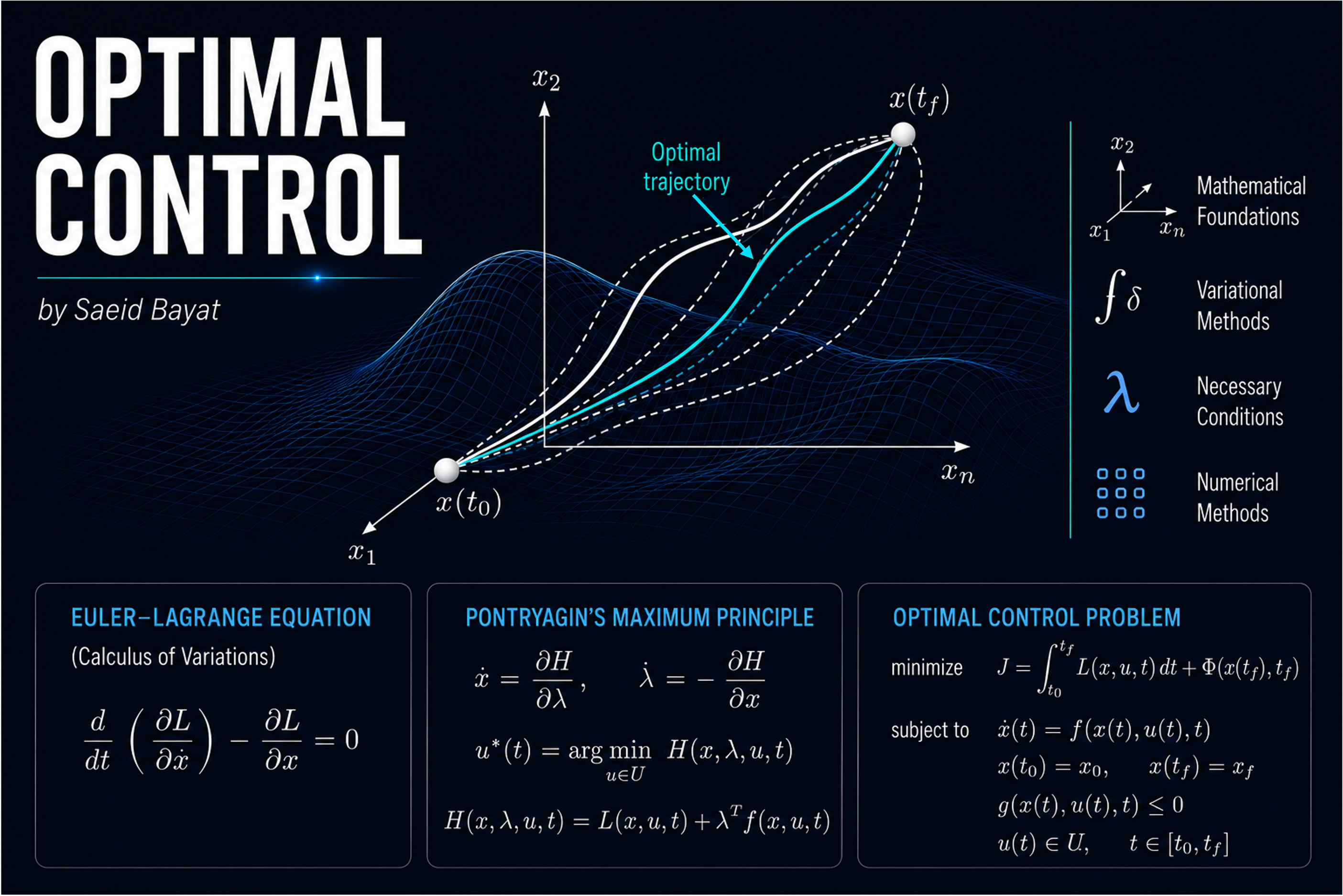
This course is designed for graduate engineering students with a background in dynamics, control, or optimization. It presents optimal control as a coherent framework for designing control inputs and system trajectories that satisfy dynamic equations, respect practical constraints, and optimize meaningful engineering objectives. It connects mathematical theory, numerical solution methods, and engineering interpretation.
The notes cover variational methods, Pontryagin’s minimum principle, linear–quadratic control, direct transcription and collocation, pseudospectral methods, costate recovery, path constraints, dynamic programming, solution verification, and engineering applications. Reproducible examples and visual explanations emphasize both mathematical rigor and practical implementation.