Optimal Control: Theory, Computation, and Engineering Practice
by Saeid Bayat (saeidb@umich.edu; saeidbayat.com)
Overview
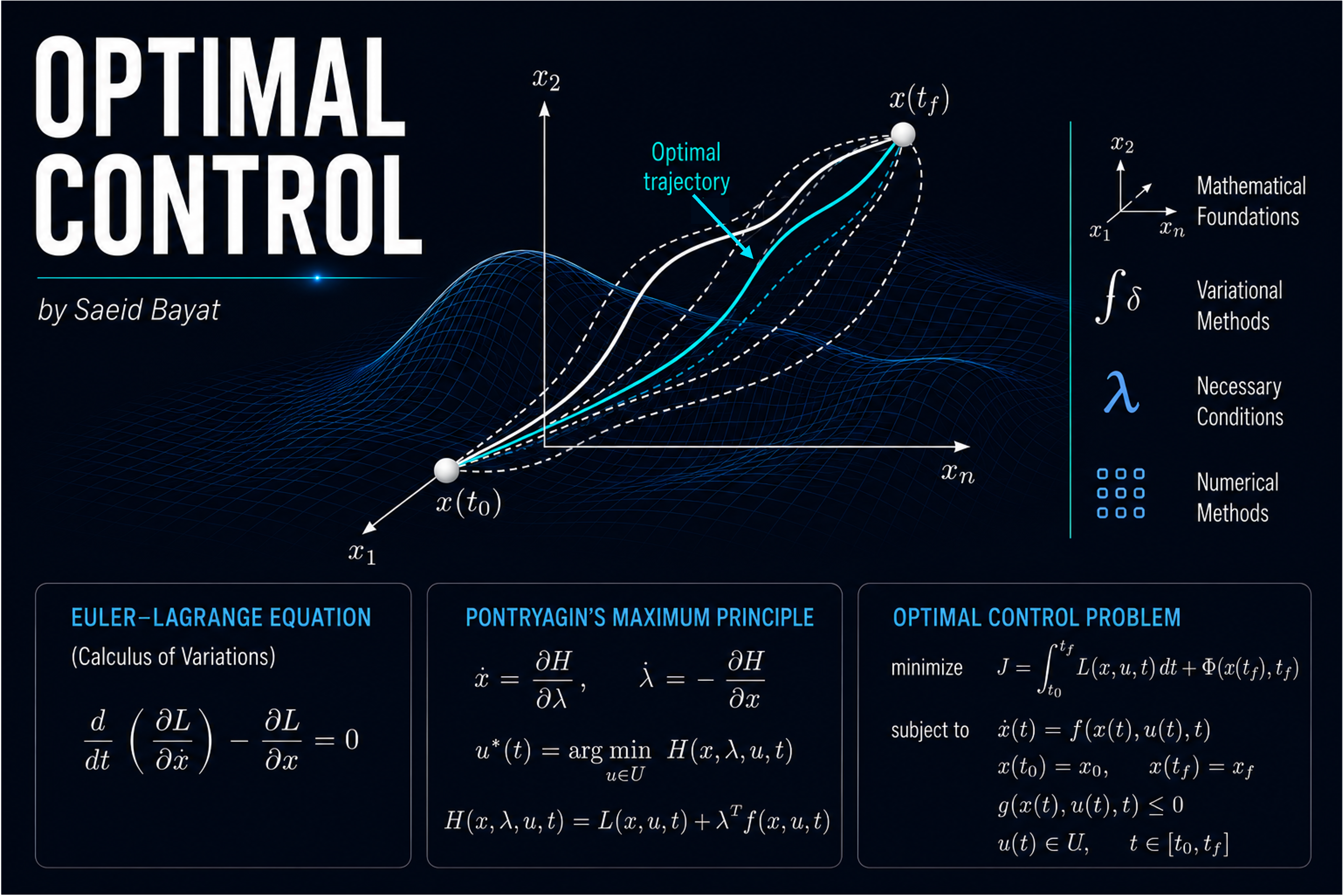
Optimal control asks how a dynamic system should act over time to achieve an objective while satisfying its governing equations and practical limitations. These notes will connect mathematical theory, numerical solution methods, feedback implementation, and engineering interpretation.
Course roadmap
Chapter 0 — Mathematical and Computational Foundations: Reviews the analysis, dynamics, optimization, and numerical tools used throughout the course.
Chapter 1 — Optimal Control Foundations: Introduces standard problem elements, cost functions, constraints, horizons, and canonical examples.
Chapter 2 — Variational Methods and PMP: Develops costates, Hamiltonians, necessary conditions, transversality, and constrained controls.
Chapter 3 — Dynamic Programming and HJB: Develops value functions, the principle of optimality, HJB equations, and feedback policies.
Chapter 4 — Linear-Quadratic Optimal Control: Studies finite- and infinite-horizon LQR, tracking, discrete-time design, and LQG.
Chapter 5 — Numerical Optimal Control: Compares shooting, transcription, and collocation and emphasizes scaling and verification.
Chapter 6 — Constrained Control and MPC: Moves from finite-horizon optimization to constrained receding-horizon feedback.
Chapter 7 — Uncertainty, Estimation, and Robustness: Introduces estimation, stochastic objectives, robust formulations, and uncertainty-aware implementation.
Chapter 8 — Applications and Advanced Topics: Integrates the course through engineering studies and selected research directions.
Why Write These Notes?
Optimal control connects dynamic-system modeling, control theory, calculus of variations, and numerical optimization, yet students are often left to assemble these connections themselves. I wrote these notes to present the subject as one coherent framework for designing control inputs and system trajectories that satisfy the dynamics, respect constraints, and optimize meaningful engineering objectives. The emphasis is not only on computing an optimal solution, but also on understanding its structure, interpreting it physically, and evaluating whether it is mathematically sound and numerically reliable. Through reproducible examples, visual explanations, and open-ended problems, these notes aim to make optimal control rigorous, intuitive, and practical for solving real engineering problems.
Acknowledgements and Feedback
I am deeply grateful to Prof. Anil V. Rao, Professor in the Department of Mechanical and Aerospace Engineering and Director of the Vehicle Dynamics and Optimization Laboratory at the University of Florida. His lectures introduced me to optimal control during my PhD studies and had a lasting influence on how I understand and teach the subject. Many of the explanations, examples, and pedagogical approaches in these notes were inspired by his teaching.
AI-assisted tools have been used selectively during drafting and visual development.
If you have feedback or suggestions, please contact me through saeidbayat.com. I would be glad to hear from students, educators, researchers, and other readers who find these notes useful.
Accessibility
I want all students to be able to engage fully with these notes. The material uses text, equations, diagrams, and computational examples to provide multiple paths to understanding, and I aim to follow WCAG 2.1 AA practices. If you encounter an accessibility barrier, please contact me through saeidbayat.com so I can improve the resource.