15.3 Ride Comfort and Suspension-Travel Metrics
Core idea
Ride Comfort and Suspension-Travel Metrics must be treated as a system-level decision rather than an isolated technique. For a quarter-car and trailing-arm suspension progressed from baseline to simultaneous, nested, MPC, and robust design, state what is fixed, what is optimized, what information is available, and what equations define feasibility.
The relevant quantities are vehicle states, spring and damper, actuator, geometry, control, road input, and preview horizon. The chapter-level formulation is
For this section, trace how the choice changes plant and actuator, the active constraints, and the implementable engineering design. A method is useful only when its assumptions are explicit and its result answers the same system question as the baseline.
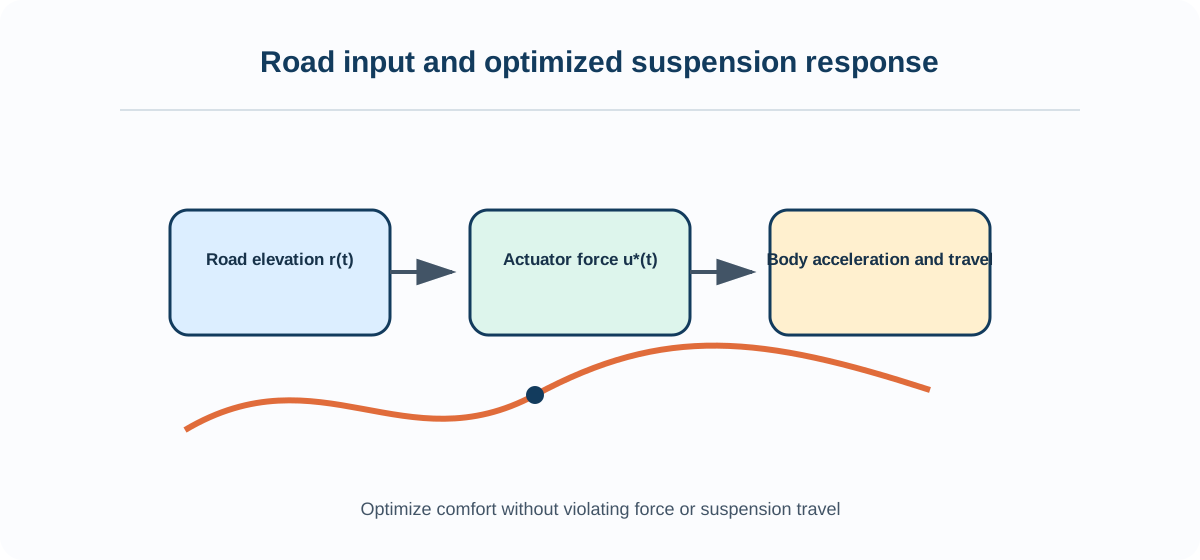
Engineering interpretation
Ask three questions:
Which physical, informational, computational, or economic resource changed?
Which objective component or active constraint made the change valuable?
Does the conclusion survive model, disturbance, initialization, uncertainty, and implementation checks?
A practical action is to solve CCD. Record units and assumptions before optimization, report component objectives and margins afterward, and verify the result using an independent calculation or higher-fidelity model.