Reproducibility and Validation
CCD studies depend on model versions, meshes, derivatives, tolerances, initial guesses, scaling, random seeds, and data processing. Recording these choices allows others to recreate the design and diagnose differences.
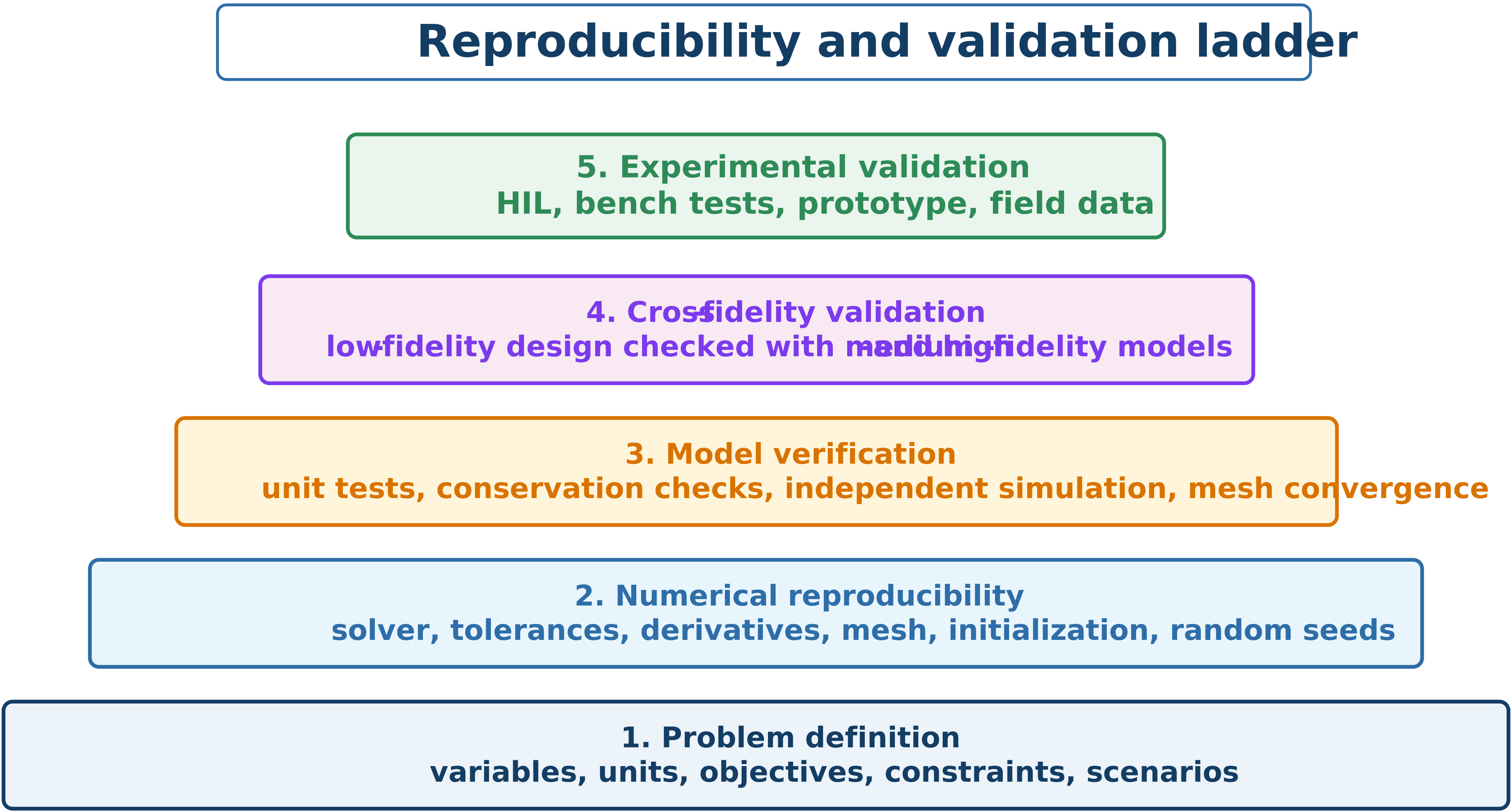
Minimum reproducibility package
A complete package should include:
governing equations, assumptions, variables, units, bounds, and scaling;
objective terms, weights, constraints, scenarios, and input data;
model and software versions;
solver algorithms, tolerances, and linear-solver settings;
derivative methods and sparsity information;
mesh, time step, and convergence study;
initial guesses, seeds, and multistart strategy;
optimized designs and trajectories;
postprocessing scripts and validation cases; and
limitations and known failure modes.
Numerical verification
Before assigning physical meaning, confirm acceptable feasibility and optimality residuals, mesh convergence, between-node feasibility in an independent simulation, derivative accuracy, consistency across starts, and freedom from hidden scaling or bound errors.
Model validation
Validation asks whether the mathematical model predicts the real or higher-fidelity system well enough for the design decision. Compare trajectories, natural frequencies and damping, loads and energy, constraint margins, stability and bandwidth, and—critically—model error near the optimized design.
Validation is not a single score. Small average error can hide critical peaks or rare failures. Match validation evidence to the design claim: fatigue claims require fatigue-driving loads; feasibility claims require extreme trajectories and constraint margins.
The standardization gap in practice
The reproducibility and validation demands described above are not yet routine practice in every CCD subfield. A recent review of wind turbine CCD found that industrial adoption remains limited in part because CCD studies rarely report enough information for one study to be compared against another: quantitative performance metrics, sensitivity analyses, and computational cost are inconsistently documented, and there is no standardized way to quantify how strongly a given system’s plant and control disciplines actually couple. The review identified this as a distinct research gap from model fidelity or uncertainty treatment — even a numerically well-verified individual study can fail to accumulate into transferable engineering knowledge if each published study uses different objectives, different constraint sets, and different reporting conventions. The remedy the review proposed for the field is exactly the reproducibility package emphasized in this chapter: standard, reproducible benchmark problems that let independent groups reproduce a claimed result and directly compare coordination strategies on identical terms, rather than reproducing only the qualitative conclusion that “coordination helps.”
Activity 8.6: Independent Reproduction and Validation Audit
Activity 8.6: Independent Reproduction and Validation Audit
A research team reports an optimized CCD design
with objective , maximum path-constraint violation below 10-6, and a claimed improvement over a sequential baseline. Perform an independent reproduction and validation audit.
Define a reproducibility package containing:
governing equations;
units and variable definitions;
initial and boundary conditions;
objective weights;
all constraints and bounds;
software versions;
solver settings;
initialization;
random seeds; and
raw and processed data.
Recompute the reported objective using an independent implementation.
Define the relative objective discrepancy
Independently simulate the reported control law and compute the maximum trajectory discrepancy
Re-evaluate every path constraint on a dense grid and report
Repeat the optimization using:
at least ten initial guesses;
two mesh densities;
two NLP solvers or algorithms; and
two derivative methods.
Reconstruct the sequential baseline using exactly the same model, objective, constraints, tolerances, and information assumptions as the CCD problem.
Compute the verified improvement
Test both designs under uncertainty and at a higher model-fidelity level.
Define explicit acceptance criteria for
Classify the final conclusion as one of the following:
numerically reproduced and physically validated;
numerically reproduced but not physically validated;
partially reproduced; or
not reproduced.
Explain why an optimizer success message and a low reported objective are insufficient evidence for a credible CCD result.