Chapter 12: Model Fidelity, Surrogates, and Data-Driven CCD
Obtaining useful models without making optimization impossible
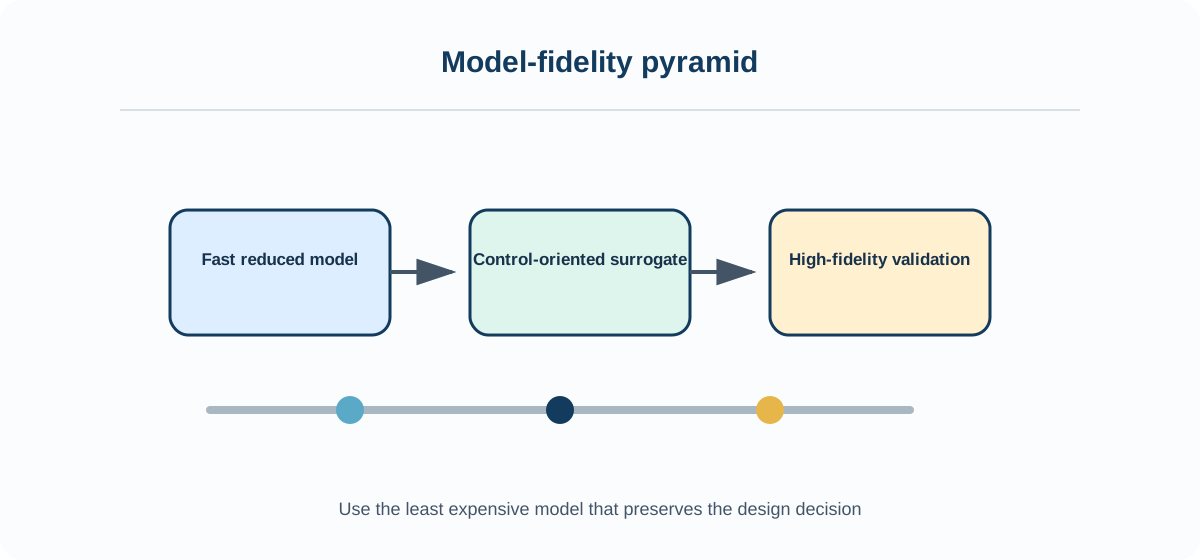
A useful CCD model preserves decision-driving couplings while remaining inexpensive, differentiable, and robust enough for repeated optimization. Fidelity is a managed hierarchy.
Learning objectives
After completing this chapter, you should be able to:
explain and apply high-fidelity simulation;
explain and apply training data;
explain and apply dynamic surrogate;
explain and apply optimization;
formulate and verify the chapter methods on a floating wind turbine modeled in OpenFAST and with reduced, LPV, and derivative-function surrogates.
Mathematical lens
The recurring quantities are high-fidelity , surrogate , design , and model error :
Running example
The recurring example is a floating wind turbine modeled in OpenFAST and with reduced, LPV, and derivative-function surrogates. Retaining one system prevents apparent improvements from being caused by changed physics, information, loads, or metrics.
Recommended workflow
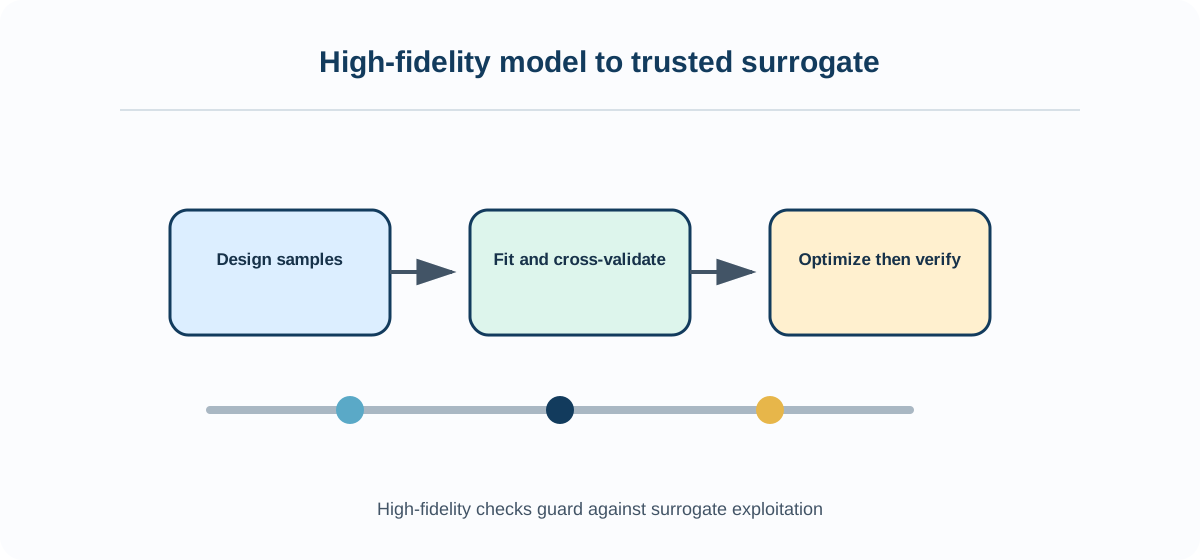
sample high fidelity.
identify reduced model.
train surrogate.
validate trajectories.
optimize and confirm.
Chapter map
Analysis Models Versus Optimization Models
Control-Oriented Modeling
Linearization and Local Models
Reduced-Order Models
Response-Surface Surrogates
Dynamic Surrogate Models
Derivative-Function Surrogate Models
Linear Parameter-Varying Models
Gaussian Processes and Neural Networks
Multi-Fidelity Optimization
Model-Error Assessment and Trust
High-Fidelity Validation