Lagrange, Mayer, and Bolza Objectives
The objective defines what “good” means. CCD objectives may represent energy, ride quality, tracking error, power, structural load, cost, or combinations of goals.
Lagrange form
The Lagrange form accumulates a running cost:
It is appropriate for total energy, integrated tracking error, mean-squared acceleration, or accumulated control effort. For example,
Mayer form
The Mayer form depends only on terminal quantities:
Examples include minimizing final error or final time and maximizing final stored energy:
Bolza form
The Bolza form combines terminal and running terms:
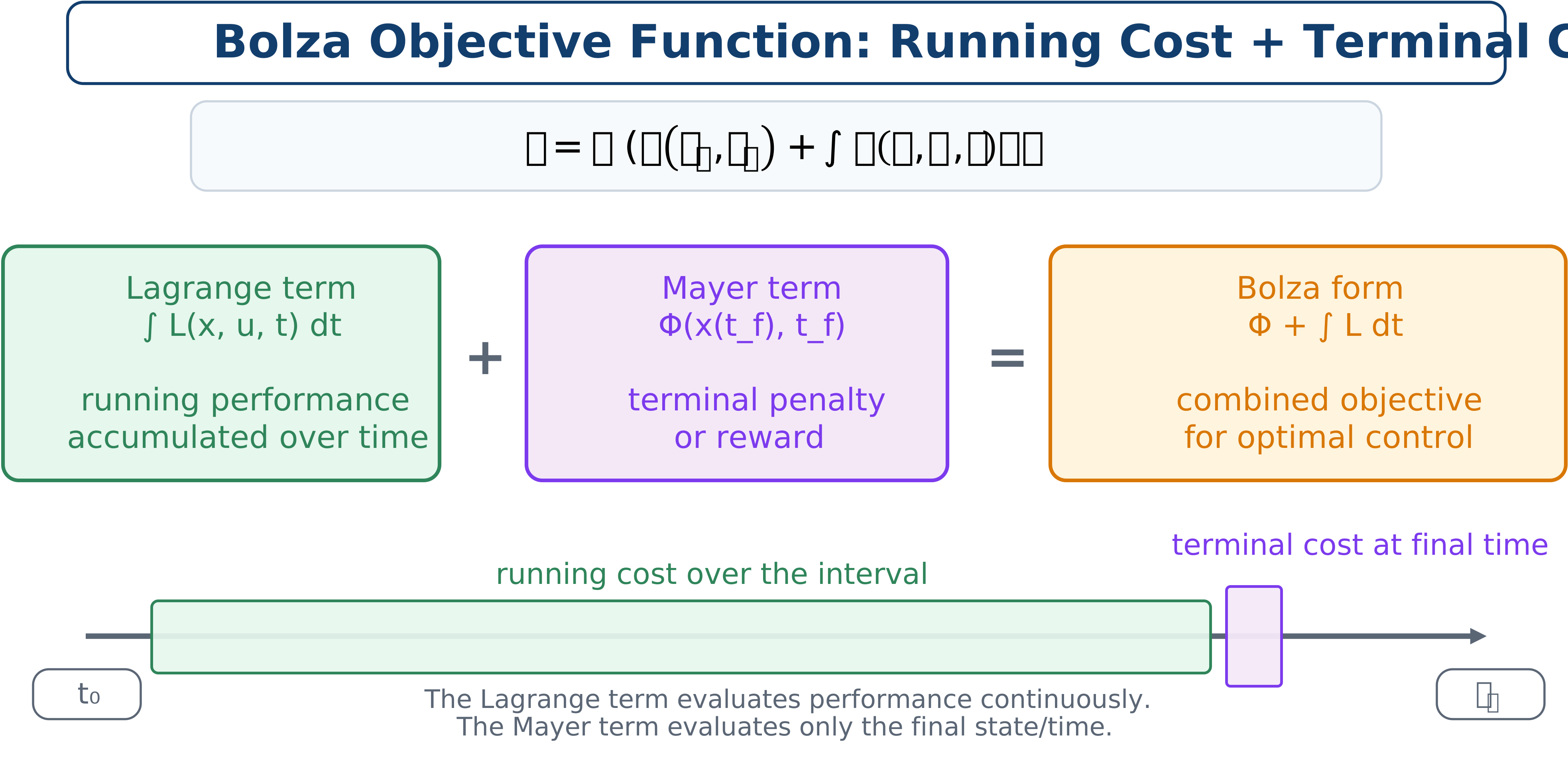
Lagrange, Mayer, and Bolza objective forms.
The forms are closely related. Lagrange and Mayer problems are special cases of Bolza. A Bolza problem can also be rewritten in Mayer form by introducing an auxiliary state. Keeping the conceptual distinction makes engineering formulations easier to interpret.
A more general terminal term
Some CCD formulations let the terminal-cost term depend on the initial state as well as the final state,
This more general Mayer term is useful whenever performance depends on how the state has changed between endpoints rather than on the terminal state alone—for example, a periodicity requirement, or an objective that rewards net displacement over a maneuver. The form used above is the common special case in which does not depend on .
Activity 4.2: Conversion among Lagrange, Mayer, and Bolza Forms
Activity 4.2: Conversion among Lagrange, Mayer, and Bolza Forms
Consider the dynamic optimization problem
subject to
Introduce an auxiliary state and convert the Lagrange objective into an equivalent Mayer objective.
State the initial condition for and write the augmented dynamics.
Prove that
Now consider the Bolza objective
Convert it into a pure Mayer problem.
Add the integral energy constraint
Introduce another auxiliary state and rewrite the integral inequality as a terminal boundary constraint.
Show that the resulting augmented system contains no integral objective or integral constraint.
Explain why the Mayer transformation is mathematically exact but may still affect numerical conditioning and scaling.
Generalize the transformation to the vector running cost