AI-Guided System Architecture and Learning
As engineering systems become increasingly complex, their architectural design spaces expand combinatorially. This growth makes exhaustive optimization infeasible and limits the ability to extract reusable design patterns that generalize across systems. My research addresses this challenge by developing AI-guided frameworks that systematically explore large configuration spaces, learn high-performing patterns, and extract interpretable design principles from optimized solutions.
One core contribution is the development of a multi-split configuration framework for fluid and thermal management systems, which integrates topology generation, flow optimization, and performance evaluation. This approach enables the systematic exploration of thousands of architectures that were previously too complex for traditional workflows. Building on this foundation, I introduced data-driven techniques that identify recurring structural and functional design patterns through clustering, dimensionality reduction, and feature analysis. These methods extract interpretable, reusable insights that inform future design decisions rather than treating each optimization result as an isolated solution.
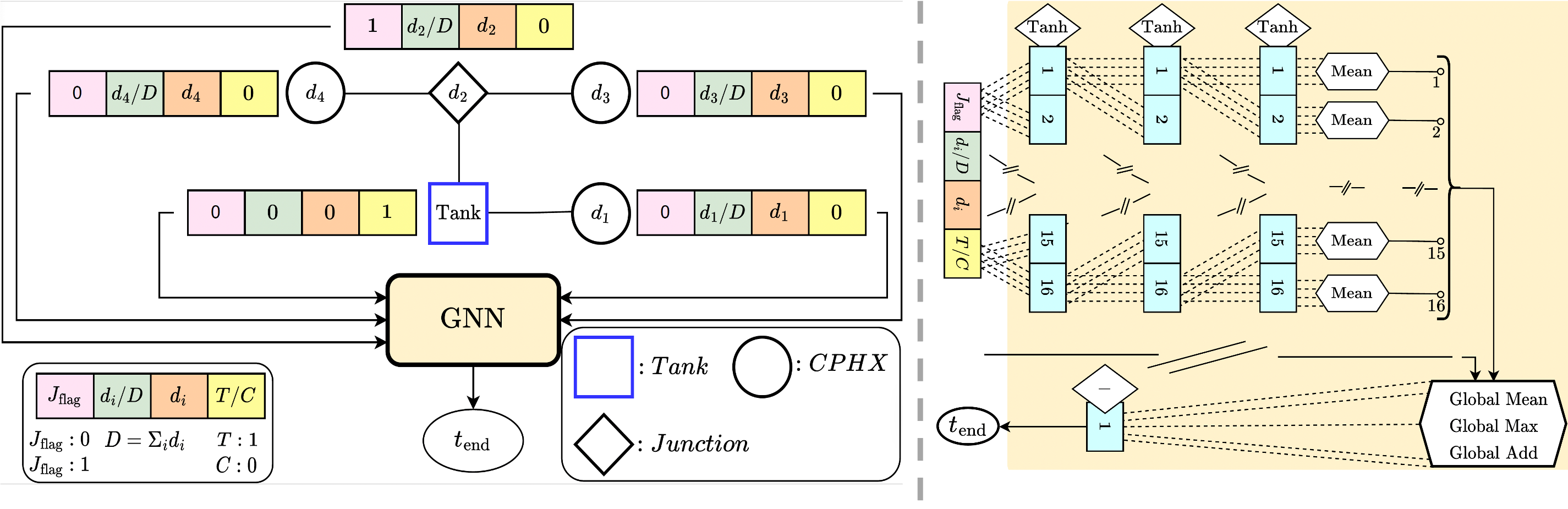
This research direction further advances through graph-based learning, where system architectures are represented as component–flow graphs and evaluated using graph neural networks (GNNs). These models learn both topology and performance relationships, predicting system behavior with high accuracy while reducing evaluation time by more than an order of magnitude. GNN-based surrogates make large-scale architecture optimization possible and reveal underlying physical relationships embedded in the design space.
More broadly, these AI-guided frameworks generalize to many classes of engineered systems with complex interactions and large configuration spaces. They are applicable wherever design involves networked components, interacting subsystems, or multi-physics couplings—ranging from robotics and dynamic mechanical systems to distributed energy networks and advanced thermal systems. Together, these works establish a scalable, interpretable methodology for learning from optimized architectures, accelerating architecture evaluation, and uncovering generalizable principles that guide future engineered systems.
Key Contributions
- Developed a multi-split configuration framework integrating automated topology generation, flow optimization, and system-level performance evaluation.
- Created data-driven tools that extract interpretable design rules by analyzing optimized architectures through clustering and feature discovery.
- Designed graph neural network (GNN) models that represent system architectures as component–flow graphs and predict performance with high accuracy at a fraction of the computational cost.
- Demonstrated that AI-guided design frameworks generalize to a wide range of engineered systems with large configuration spaces and complex subsystem interactions.
Selected Publications
Bayat, S., Shahmansouri, N., Peddada, S. R. T., Tessier, A., Butscher, A., and Allison, J. T.
“Multi-Split Configuration Design for Fluid-Based Thermal Management Systems.”
Journal of Mechanical Design, 147(2):021705 (2025).
LinkBayat, S., Shahmansouri, N., Peddada, S. R. T., Tessier, A., Butscher, A., and Allison, J. T.
“Extracting Design Information From Optimized Designs of Power Flow Systems: Application to Multisplit Thermal Management System Configuration.”
Journal of Mechanical Design, 147(11):112001 (2025).
LinkBayat, S., Shahmansouri, N., Peddada, S. R. T., Tessier, A., Butscher, A., and Allison, J. T.
“Can Graph Neural Networks Help Identify Promising Thermal Management System Architectures Among Vast Numbers of Possibilities?”
Journal of Mechanical Design, (2025).
Link